
AS June 2023 Q4
4.
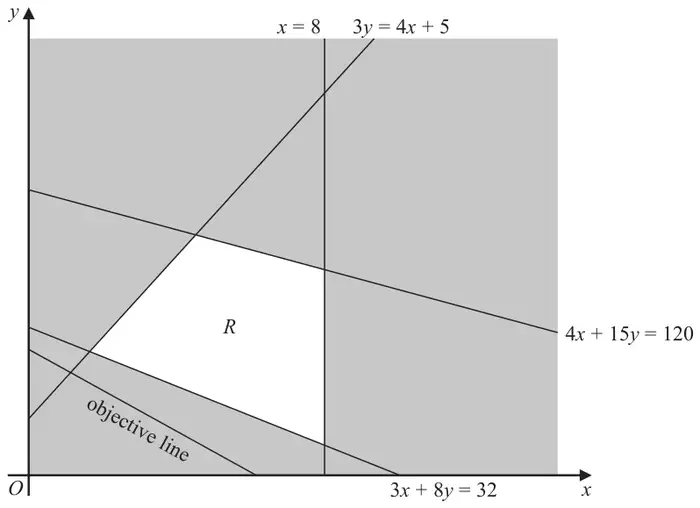
Figure 3 shows the constraints of a linear programming problem in \(x\) and \(y\).
The unshaded area, including its boundaries, forms the feasible region, \(R\).
An objective line has been drawn and labelled on the graph.
The maximum value of the objective function is \(\dfrac{160}{3}\)
The minimum value of the objective function is \(\dfrac{883}{41}\)
| Scheme | Marks | AO |
|---|---|---|
| \(x \leqslant 8,\quad 3x + 8y \geqslant 32,\quad 3y \leqslant 4x + 5,\quad 4x + 15y \leqslant 120\) | B2, 1, 0 | 3.3 1.1b |
| (2) |
Notes
B1: Any two correct inequalities. Condone strict inequalities
B1: All four correct inequalities (not strict)
| Scheme | Marks | AO |
|---|---|---|
| Attempt to solve correct two equations to find either optimal vertex Coordinates of ‘minimum’ point is \(\left(\dfrac{56}{41},\ \dfrac{143}{41}\right)\) Coordinates of ‘maximum’ point is \(\left(8,\ \dfrac{88}{15}\right)\) | M1 A1 A1 | 3.4 1.1b 1.1b |
| Setting up a pair of simultaneous equations using their two points and an objective function of the form \(ax + by\) (If correct \(\begin{aligned}56a + 143b &= 883\\ 15a + 11b &= 100\end{aligned}\) oe) | dM1 | 3.1a |
| Objective function is \((P =)\,3x + 5y\) | A1 | 2.2a |
| (5) | ||
| (7 marks) |
Notes
M1: Considering either of the following pairs of simultaneous equations:
\(3y = 4x + 5,\ 3x + 8y = 32\) or \(x = 8,\ 4x + 15y = 120\)
Must find at least one pair of coordinates from either of these two pairs (condone poor algebra in the solving of these equations)
A1: cao \(\left(\dfrac{56}{41},\ \dfrac{143}{41}\right)\) - must be seen exact at some point. They do not have to associate this with being the ‘minimum’
A1: cao \(\left(8,\ \dfrac{88}{15}\right)\) - must be seen exact at some point. They do not have to associate this with being the ‘maximum’
dM1: Setting up a pair of linear simultaneous equations using their two points. For this mark they must be using their solution of \(3y = 4x + 5,\ 3x + 8y = 32\) together with \(\dfrac{883}{41}\) and their solution of \(x = 8,\ 4x + 15y = 120\) together with \(\dfrac{160}{3}\). Allow use of any two different variables for their pair of linear simultaneous equations. Look out for \(\dfrac{56}{41}x + \dfrac{143}{41}y = \dfrac{883}{41}\) and \(8x + \dfrac{88}{15}y = \dfrac{160}{3}\) which implies the first four marks
A1: cao – allow just the expression \(3x + 5y\) but not any multiple or factor of this (but isw if correct expression is seen first). Allow equal to any other letter but not equal to a value, for example, \(3x + 5y = 0\) is A0