
AS June 2018 Q1
1.
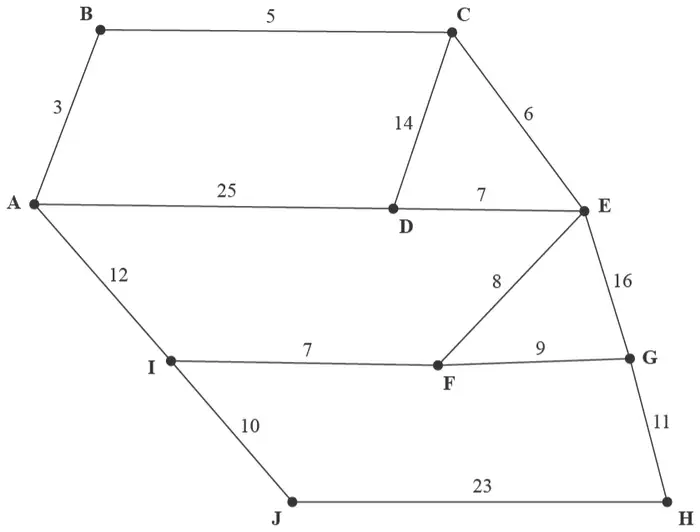
Figure 1 represents a network of roads.
The number on each arc represents the time taken, in minutes, to drive along the corresponding road.
For a network with \(n\) vertices, Dijkstra’s algorithm has order \(n^2\)
| Scheme | Marks | AO |
|---|---|---|
(i)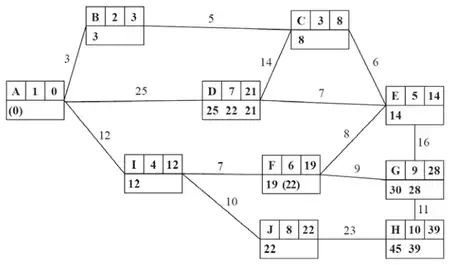 | M1 A1 A1 A1ft | 1.1b 1.1b 1.1b 1.1b |
| Shortest time to travel from A to H is 39 minutes | A1ft | 1.1b |
| (ii) Quickest route is AIFGH | A1 | 1.1b |
| (6) |
Notes
(a)(i) M1: For a larger number replaced by a smaller number in the working value boxes at either D, G or H
A1: For all values correct (and in correct order) at A, B, C, I and E
A1: For all values correct (and in correct order) at F and D
A1ft: For all values correct (and in correct order) on the follow through at J, G and H
A1ft: Follow through their final value at H (condone lack of units)
(a)(ii) A1: Cao (AIFGH)
| Scheme | Marks | AO |
|---|---|---|
| \(1.5 \times \left(\dfrac{9500}{250}\right)^2\) | M1 | 1.1a |
| = 2166 seconds | A1 | 1.1b |
| (2) |
Notes
M1 Complete method – allow 250/9500 (but must be squared) – allow slips in values e.g. 950 for 9500
A1: Cao (accept 2170 but only with correct working) – accept 2166 with no working for M1 only
| Scheme | Marks | AO |
|---|---|---|
| order of \(n^2\) does not mean that the order is proportional to \(n^2\) (which is the assumption behind the answer in (b)) but merely means that the dominant term is of order \(n^2\) | B1 | 3.2b |
| (1) | ||
| (9 marks) |
Notes
B1: Any indication that the run-time is not exactly proportional to \(n^2\) e.g. may suggest that there are other terms (\(n^2 + \ldots\)), or that \(n^2\) is the dominant term, or that order does not imply proportionality. Do not accept only that ‘\(n^2\) is not exact’.