
June 2022 Paper 1 Q17
17 The point \(P\) lies on the circle \(\quad x^2 + y^2 = 16\)
The line \(OP\) is at an angle of \(60^\circ\) to the positive \(x\)-axis.
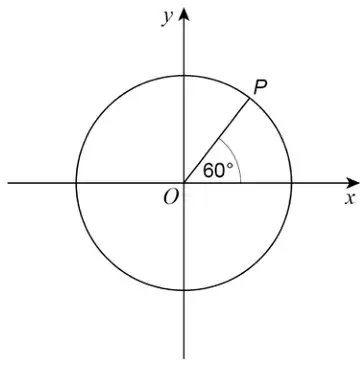
Not drawn accurately
(a) Show that the coordinates of point \(P\) are \((2, 2\sqrt{3})\) [2 marks]
(b) Work out the equation of the tangent to the circle at \(P\).
Write your answer in the form \(\quad x + ay = b \quad\) where \(a\) and \(b\) are constants. [4 marks]
| Answer | Mark | Comments |
|---|---|---|
| Alternative method 1 | ||
| Radius of circle = 4 | M1 | 4 could be seen in the solution or diagram without the word radius stated |
| Use of 4cos 60 and 4sin 60 and \(4 \times \dfrac{1}{2}\) and \(4 \times \dfrac{\sqrt{3}}{2}\) | A1 | \(= (2, 2\sqrt{3})\) candidates could use the sine rule but it should look like this anyway |
| Alternative method 2 | ||
| \(1 : \sqrt{3} : 2\) triangle seen or stated | M1 | Pythagorean triple |
| \(2 : 2\sqrt{3} : 4\) | A1 | |
| Alternative method 3 | ||
| \(\tan 60 = \dfrac{\text{opp}}{\text{adj}} = \dfrac{2\sqrt{3}}{2} = \sqrt{3}\) or \(\dfrac{\text{opp}}{\text{adj}} = \dfrac{2\sqrt{3}}{2} = \sqrt{3} = \tan 60\) | B1 | shows that the point is on the line \(OP\) |
| \((2\sqrt{3})^2 + 2^2 = 12 + 4 = 16\) | B1 | shows that the point lies on the circle |
Additional guidance
| Candidates could find one coordinate and then substitute into the circle equation to show the second coordinate Candidates may try to use multiple alt methods – mark according to the method that gives them the best mark It is possible to show that the \(x\) coordinate is 2 by connecting \(P\) and (4,0) hence creating an equilateral triangle (this would need to be stated). Then drop a perpendicular from \(P\) which bisects the base line showing that the \(x\) coordinate is 2 | M1A1 |
| Answer | Mark | Comments |
|---|---|---|
| (Gradient of \(OP\) =) \(\dfrac{2\sqrt{3}}{2}\) or \(= \sqrt{3}\) | M1 | \(\sqrt{3}\) either from part (a) or knowing that an angle of \(60^\circ\) gives it |
| (Gradient of tangent =) \(\dfrac{-1}{\text{their}\sqrt{3}}\) | M1 | oe \(\dfrac{-1}{\sqrt{3}}\) would imply the first M mark |
| \(y - 2\sqrt{3} = \dfrac{-1}{\sqrt{3}}(x - 2)\) or \(2\sqrt{3} = \dfrac{-1}{\sqrt{3}}(2) + c\) | M1dep | oe dependent on M2 already being awarded \(c = \dfrac{8\sqrt{3}}{3}\) |
| \(x + \sqrt{3}\,y = 8\) | A1 |