
MOG 2019 Q2
Beth has a black counter and Wendy has a white counter. Beth and Wendy move their counters on the two boards below according to the starting positions and rules given. They always move their counters at the same time.

Hint You may find it helpful to refer to the colours of the squares on the board in your explanation.(3 marks)
At each turn, each player moves their counter to a triangular cell which shares one edge with the cell that their counter is currently in. Can their counters ever be in the same cell at the same time?(7 marks)
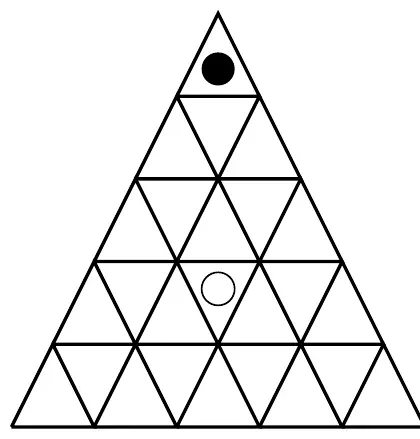
Hint If you think the two counters can never be in the same cell at the same time, you should give an argument that they cannot be in the same cell at the same time which works no matter which sequence of moves Beth and Wendy do. If you think the two counters can be in the same cell at the same time, you should give an example of a sequence of moves after which they are in the same cell at the same time.
Mathematical Olympiad for Girls 2019, Question 2. © UK Mathematics Trust. Original paper on ukmt.org.uk
Answer: (b) No
Commentary
In a problem like this, it is tempting to try to think of all possible ways that the two counters can move and find a “worst possible” or “best possible” sequence of moves. Another strategy would be to consider where the counters were the move before they were in the same square and then “work backwards” to the starting position. It turns out that, in many cases, both of these strategies are either impractical (because there are too many possible sequence of moves) or impossible (because, like here, the counters can keep moving forever without meeting).
Instead, you need to think of some property of the game that means that the counters can never be in the same square. The hint in part (a) suggests thinking about how the colour of each counter’s square changes with each move.
Once you have seen that considering the colours of the cells is useful in part (a), you may want to try a similar strategy in part (b). You need to decide how to colour the triangular cells so that each move changes the colour of the counter’s cell. You also need to show that, with your colouring, the black and the white counter start on different colours.
Since the colours of the squares on the board alternate, each move (one square to the left or one square to the right) changes the colour of the square that the counter is in. The two counters start on different colours so, since each one changes the colour at each turn, they will always be on different colours. This means that they can never be in the same square at the same time.
Colour the triangular cells black and white as shown in the diagram.
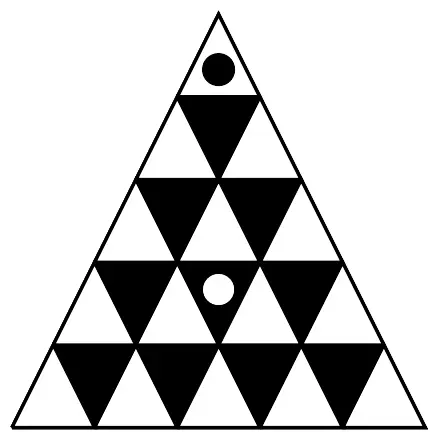
Then two cells which share an edge are different colours. Hence each move changes the colour of the counter’s cell.
As can be seen in the diagram, the black and the white counter start on different colours. Therefore they will always be on different colours, and so cannot be in the same cell at the same time.
Solution © UK Mathematics Trust, from the MOG 2019 solutions.