
Cayley 2017 Q2
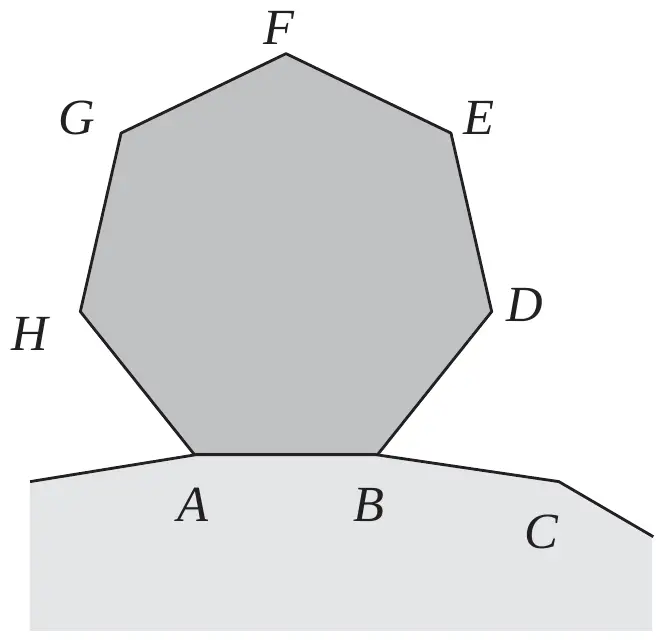
The diagram shows three adjacent vertices \(A\), \(B\) and \(C\) of a regular polygon with forty-two sides, and a regular heptagon \(ABDEFGH\). The polygons are placed together edge-to-edge.
Prove that triangle \(BCD\) is equilateral.
Cayley Olympiad 2017, Question 2. © UK Mathematics Trust. Original paper on ukmt.org.uk
One can prove that a triangle is equilateral in several different ways, and the diagram gives a few hints about which will be easiest. Two of the sides and one of the angles look more important than the other side and the other two angles, so we'll talk about them.
All sides of the heptagon are of equal length, so \(AB = BD\); similarly all sides of the 42-sided polygon are of equal length, so \(AB = BC\). Thus \(BD = BC\), making triangle \(DBC\) isosceles.
We'll now compute the angle \(DBC\) by extending the common side of the two polygons to \(X\), as shown in the diagram alongside. We see that angle \(DBC\) is the sum of the external angles of two regular polygons.
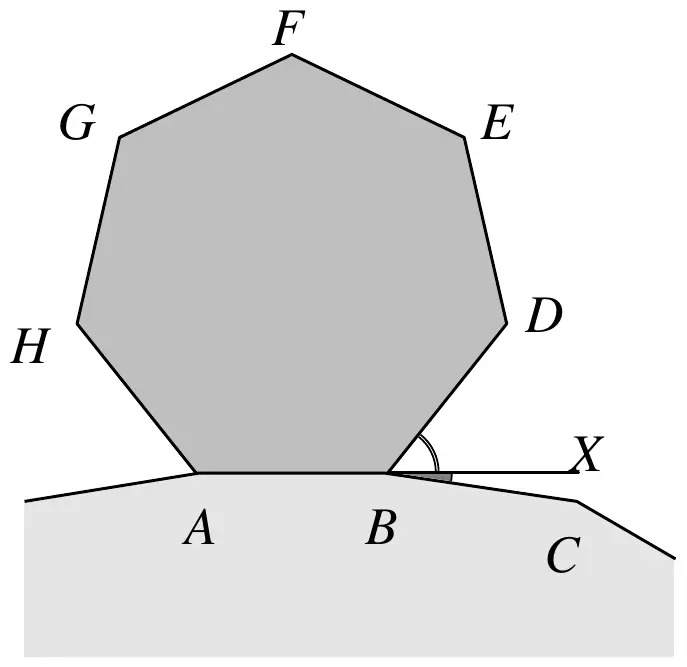
Thus
\[\begin{aligned} \angle DBC &= \angle DBX + \angle XBC\\ &= \frac{360^\circ}{7} + \frac{360^\circ}{42}\\ &= \left(\frac{1}{7} + \frac{1}{42}\right) \times 360^\circ\\ &= \frac{1}{6} \times 360^\circ\\ &= 60^\circ. \end{aligned}\]
Hence \(DBC\) is an isosceles triangle with an angle of 60°, which means that it is equilateral.
Solution © UK Mathematics Trust, from the Cayley Olympiad 2017 solutions.