
Cayley 2016 Q6
6. The diagram shows two regular heptagons \(ABCDEFG\) and \(APQRSTU\). The vertex \(P\) lies on the side \(AB\) (and hence \(U\) lies on the side \(GA\)). Also, \(Q\) lies on \(OB\), where \(O\) is the centre of the larger heptagon.
Prove that \(AB = 2AP\).
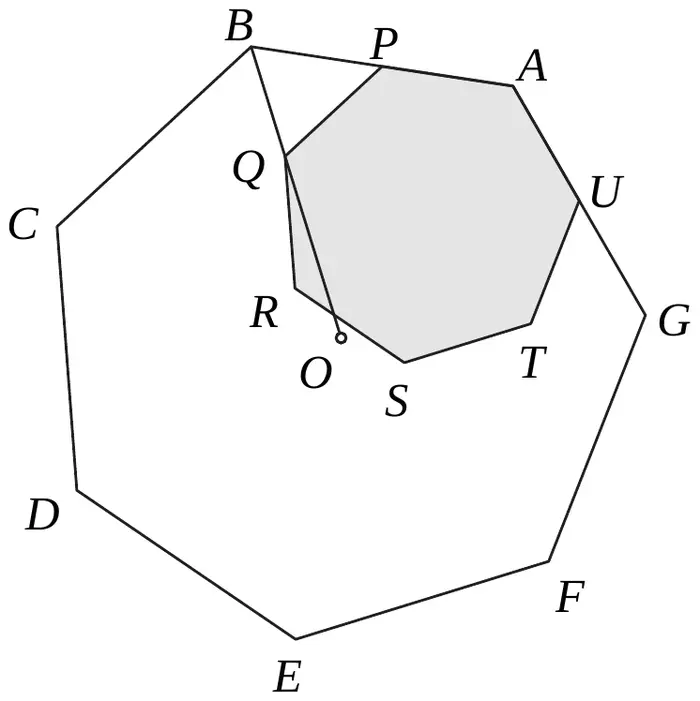
Cayley Olympiad 2016, Question 6. © UK Mathematics Trust. Original paper on ukmt.org.uk
We will show that \(PQ = PB\). Then it will follow that \(AP = PB\), because \(AP\) and \(PQ\) are two sides of a regular heptagon, and hence that \(AB = 2AP\).
Draw the lines \(OA\) and \(OC\) and extend \(AB\) to \(X\), as shown.
Now the angles \(CBX\) and \(QPB\) are equal because each is an exterior angle of a regular heptagon. Thus \(BC\) is parallel to \(PQ\) (corresponding angles converse), and therefore angle \(OBC\) is equal to angle \(BQP\) (alternate angles).
Consider triangles \(OAB\) and \(OCB\). The side \(OB\) is common, the sides \(OA\) and \(OC\) are equal because \(O\) is the centre of the larger heptagon, and the sides \(AB\) and \(BC\) are equal because the heptagon is regular.
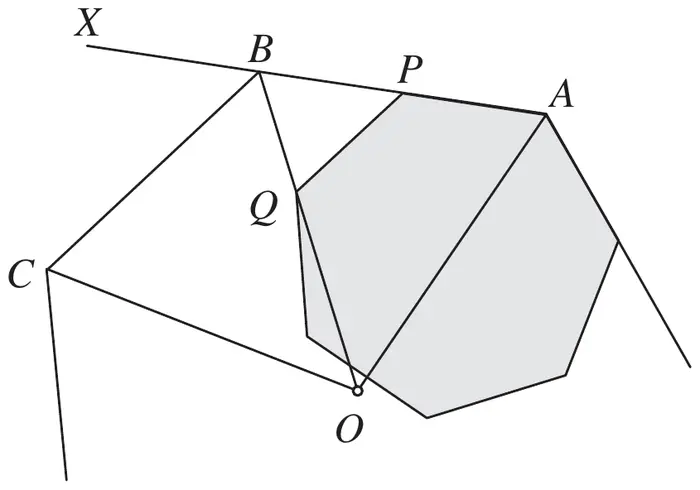
Thus triangles \(OAB\) and \(OCB\) are congruent (SSS), and therefore angle \(OBC\) is equal to angle \(OBA\), which is the same as angle \(PBQ\).
Hence the angles \(PBQ\) and \(BQP\) are equal. Therefore, using ‘sides opposite equal angles are equal’ in the triangle \(BQP\), we get \(PQ = PB\) as required.
Solution © UK Mathematics Trust, from the Cayley Olympiad 2016 solutions.