
PK 2016 Q19
19. A 5 × 5 square is divided into 25 cells. Initially all its cells are white, as shown. Neighbouring cells are those that share a common edge. On each move two neighbouring cells have their colours changed to the opposite colour (white cells become black and black ones become white).
What is the minimum number of moves required in order to obtain the chess-like colouring shown on the right?
- A 11
- B 12
- C 13
- D 14
- E 15
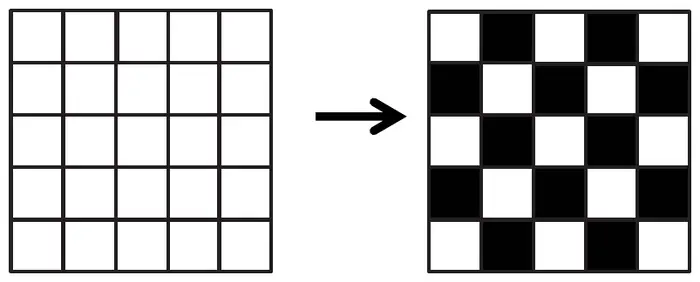
Pink Kangaroo 2016, Question 19. © UK Mathematics Trust. Original paper on ukmt.org.uk
Answer: B 12
Note that, for each black square that we wish to produce, there will need to be a move which makes it black. This move will not change the colour of any of the other squares which we wish to make black (since the desired black cells are not neighbouring). Since there are 12 such squares, we must necessarily make at least 12 moves.
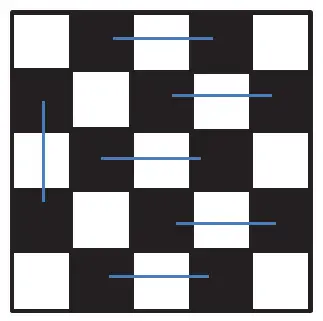
However, we can show that 12 moves are sufficient. Consider a pair of black cells with a white cell between them. This colouring can be made in two moves as follows: Starting with WWW, change the colours of two adjacent cells to obtain BBW, then change the middle cell and the one on its right to obtain BWB. By pairing off the 12 black cells into 6 pairs as shown, it is possible to create 12 black cells in \(6 \times 2 = 12\) moves.
Solution © UK Mathematics Trust, from the PK 2016 solutions.