
GK 2018 Q22
22. Dominoes are said to be arranged correctly if, for each pair of adjacent dominoes, the numbers of spots on the adjacent ends are equal. Paul laid six dominoes in a line as shown in the diagram.

He can make a move either by swapping the position of any two dominoes (without rotating either domino) or by rotating one domino. What is the smallest number of moves he needs to make to arrange all the dominoes correctly?
- A 1
- B 2
- C 3
- D 4
- E 5
Grey Kangaroo 2018, Question 22. © UK Mathematics Trust. Original paper on ukmt.org.uk
Answer: C 3
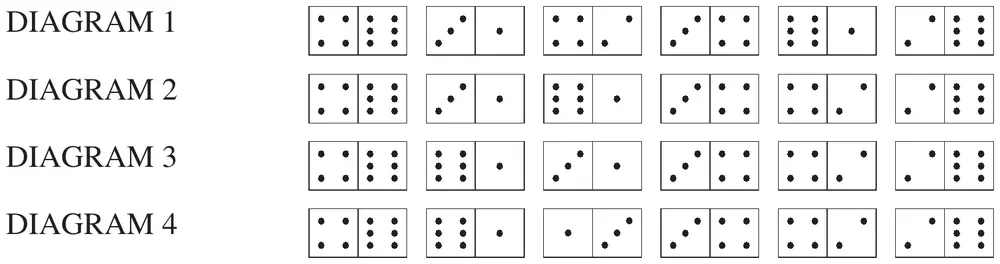
The dominoes in the line contain three ends with four spots and three ends with six spots, as shown in diagram 1. Therefore, a correctly arranged set of these dominoes will have four spots at one end and six spots at the other, as is currently the case. Hence, Paul does not need to move either of the end dominoes.
If he swaps the third and the fifth dominoes from diagram 1, he obtains the row shown in diagram 2 which has the same number of spots in the adjacent ends of the fourth, fifth and sixth dominoes. Next, if he swaps the second and third dominoes from diagram 2 to obtain the line shown in diagram 3, he has matched the spots at the adjacent ends of the first and second dominoes. Finally, rotating the third domino in diagram 3, he obtains the correctly arranged line as shown in diagram 4. This shows that it is possible to arrange the dominos correctly in three moves.
To see that two moves is not sufficient, note that, whatever else needs to happen, the two 1s must be correctly placed next to each other. To do that requires one of the dominos with a 1 to be rotated and then one pair of dominos to be swapped so that the two 1s are now next to each other. A similar argument applies to the two dominos with a 3. However, this is not possible in only two moves. Therefore the smallest number of moves he needs to make is 3.
Solution © UK Mathematics Trust, from the GK 2018 solutions.