
JK 2019 Q19
19. In the diagram, \(PQRS\) is a square of side 10 cm. The distance \(MN\) is 6 cm. The square is divided into four congruent isosceles triangles, four congruent squares and the shaded region.
What is the area of the shaded region?
- A 42 cm2
- B 46 cm2
- C 48 cm2
- D 52 cm2
- E 58 cm2
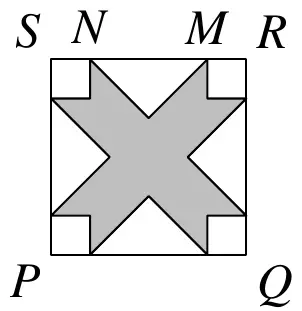
Junior Kangaroo 2019, Question 19. © UK Mathematics Trust. Original paper on ukmt.org.uk
Answer: C 48 cm2
Since the non-shaded squares are congruent and since \(MN = 6\) cm, both \(SN\) and \(MR\) have length (10 − 6) cm ÷ 2 = 2 cm. Therefore the areas of the four non-shaded squares are each (2 × 2) cm2 = 4 cm2.
Label the point \(X\) on \(SP\) as shown. Since all of the non-shaded squares are congruent, the lengths of \(SM\) and \(SX\) are equal and hence triangle \(MSX\) is an isosceles, right-angled triangle with angles of 90°, 45° and 45°. Therefore, since the non-shaded triangles are all isosceles and have an angle of 45°, they are also right-angled. Therefore these four triangles can be fitted together to form a square of side-length 6 cm. Hence the total area of the non-shaded triangles is (6 × 6) cm2. Therefore the area of the shaded region is (10 × 10 − 4 × 4 − 6 × 6) cm2 = (100 − 16 − 36) cm2 = 48 cm2.
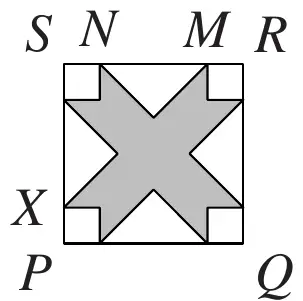
Solution © UK Mathematics Trust, from the JK 2019 solutions.