
IMC 2013 Q24
24. The diagram shows a shaded shape bounded by circular arcs with the same radius. The centres of three arcs are the vertices of an equilateral triangle; the other three centres are the midpoints of the sides of the triangle. The sides of the triangle have length 2.
What is the difference between the area of the shaded shape and the area of the triangle?
- A \(\dfrac{\pi}{6}\)
- B \(\dfrac{\pi}{4}\)
- C \(\dfrac{\pi}{3}\)
- D \(\dfrac{\pi}{2}\)
- E \(\pi\)
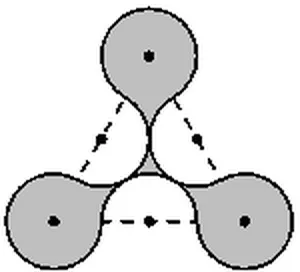
Intermediate Mathematical Challenge 2013, Question 24. © UK Mathematics Trust. Original paper on ukmt.org.uk
Answer: B \(\dfrac{\pi}{4}\)
The length of the side of the triangle is equal to four times the radius of the arcs. So the arcs have radius 2 ÷ 4 = \(\tfrac{1}{2}\).
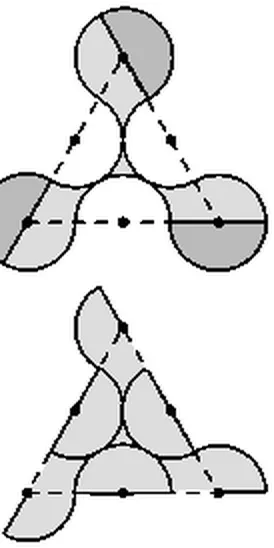
In the first diagram, three semicircles have been shaded dark grey. The second diagram shows how these semicircles may be placed inside the triangle so that the whole triangle is shaded. Therefore the difference between the area of the shaded shape and the area of the triangle is the sum of the areas of three sectors of a circle. The interior angle of an equilateral triangle is 60°, so the angle at the centre of each sector is 180° − 60° = 120°.
Therefore each sector is equal in area to one-third of the area of a circle. Their combined area is equal to the area of a circle of radius \(\tfrac{1}{2}\). So the required area is \(\pi \times \left(\tfrac{1}{2}\right)^2 = \tfrac{\pi}{4}\).
Solution © UK Mathematics Trust, from the IMC 2013 solutions. Longer versions with investigations: Solutions and investigations (PDF).