
IMC 2010 Q23
23. The diagram shows a pattern of eight equal shaded squares inside a circle of area π square units. What is the area (in square units) of the shaded region?
- A \(1\dfrac{1}{3}\)
- B \(1\dfrac{3}{5}\)
- C \(1\dfrac{2}{3}\)
- D \(1\dfrac{7}{9}\)
- E 2
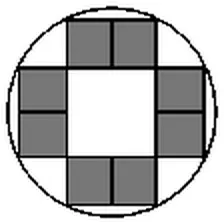
Intermediate Mathematical Challenge 2010, Question 23. © UK Mathematics Trust. Original paper on ukmt.org.uk
Answer: B \(1\dfrac{3}{5}\)
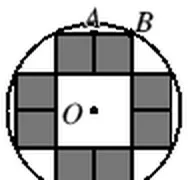
Let the centre of the circle be \(O\) and let \(A\) and \(B\) be corners of one of the shaded squares, as shown. As the circle has area π units2, its radius is 1 unit. So \(OB\) is 1 unit long. Let the length of the side of each of the shaded squares be \(x\) units.
By Pythagoras' Theorem: \(OB^2 = OA^2 + AB^2\), that is \(1^2 = (2x)^2 + x^2\).
So \(5x^2 = 1\). Now the total shaded area is \(8x^2 = 8 \times \tfrac{1}{5} = 1\tfrac{3}{5}\) units2.
Solution © UK Mathematics Trust, from the IMC 2010 solutions.