
IMC 2006 Q9
9. The diagram shows 10 identical coins which fit exactly inside a wooden frame. As a result each coin is prevented from sliding. What is the largest number of coins that may be removed so that each remaining coin is still unable to slide?
- A 1
- B 2
- C 3
- D 4
- E 5
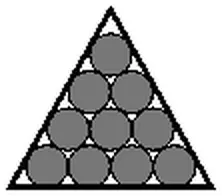
Intermediate Mathematical Challenge 2006, Question 9. © UK Mathematics Trust. Original paper on ukmt.org.uk
Answer: D 4
Note that one cannot remove two touching coins; for if you did, any third coin originally making up a triangle with them would then be slideable. Note also that it is possible to remove the centre coin and each of the coins in a corner of the frame without enabling any of the remaining coins to slide. However, as each remaining coin touched at least one of the removed coins, it is not possible to remove any further coins. If, instead, a coin other than one of these four was removed first, then it would be one of the middle pair of an edge. Four coins would have touched this coin, so that would leave five possible coins to remove. Four of the five coins would lie along an edge of the frame, with two of these forming a triangle with the fifth. Clearly, only one of the three coins which form a triangle may now be removed, together with only one of the other two coins as they are touching. So we conclude that the maximum number of coins which may be removed is four.
Solution © UK Mathematics Trust, from the IMC 2006 solutions.