
IMC 2015 Q22
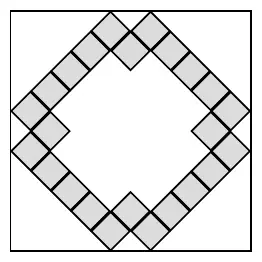
22. The diagram shows a shaded region inside a large square. The shaded region is divided into small squares.
What fraction of the area of the large square is shaded?
- A \(\dfrac{3}{10}\)
- B \(\dfrac{1}{3}\)
- C \(\dfrac{3}{8}\)
- D \(\dfrac{2}{5}\)
- E \(\dfrac{3}{7}\)
Intermediate Mathematical Challenge 2015, Question 22. © UK Mathematics Trust. Original paper on ukmt.org.uk
Answer: B \(\dfrac{1}{3}\)
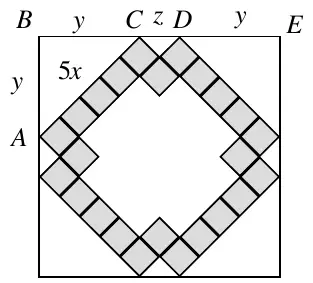
Let the length of the sides of each small square be \(x\). Then the shaded area is \(24x^2\). Let the perimeter of the square be divided into eight line segments, each of length \(y\), and four line segments of length \(z\). Some of these are labelled in the diagram. By Pythagoras' Theorem in triangle \(ABC\):
\(y^2 + y^2 = (5x)^2\), that is \(2y^2 = 25x^2\).
So \(y = \tfrac{5}{\sqrt{2}}x = \tfrac{5\sqrt{2}}{2}x\). Similarly, in the triangle with hypotenuse \(CD\):
\(x^2 + x^2 = z^2\), that is \(2x^2 = z^2\). So \(z = \sqrt{2}x\). Therefore the length of the side of the large square is \(2y + z = 5\sqrt{2}x + \sqrt{2}x = 6\sqrt{2}x\). So the area of the large square is \((6\sqrt{2}x)^2 = 72x^2\). Hence the required fraction is \(\tfrac{24x^2}{72x^2} = \tfrac{1}{3}\).
Solution © UK Mathematics Trust, from the IMC 2015 solutions. Longer versions with investigations: Solutions and investigations (PDF).