
JMC 2015 Q23
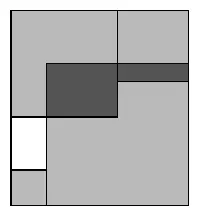
23. The diagram shows four shaded glass squares, with areas 1 cm2, 4 cm2, 9 cm2 and 16 cm2, placed in the corners of a rectangle. The largest square overlaps two others. The area of the region inside the rectangle but not covered by any square (shown unshaded) is 1.5 cm2.
What is the area of the region where squares overlap (shown dark grey)?
- A 2.5 cm2
- B 3 cm2
- C 3.5 cm2
- D 4 cm2
- E 4.5 cm2
Junior Mathematical Challenge 2015, Question 23. © UK Mathematics Trust. Original paper on ukmt.org.uk
Answer: D 4 cm2
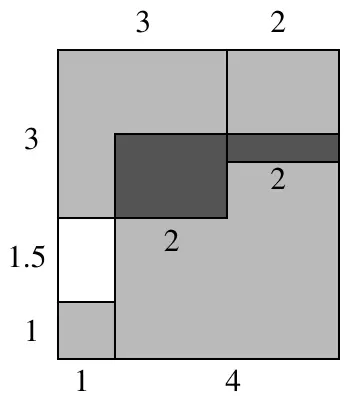
The diagram shows some of the lengths of sides which may be deduced from the information given in the question. Note that the rectangle measures 5 cm by 5.5 cm.
The sum of the areas of the four glass squares is (1 + 4 + 9 + 16) cm2 = 30 cm2. However, the total region of the rectangle occupied by the four squares is equal to (5 × 5.5 − 1.5) cm2 = 26 cm2. So the area of the overlap is (30 − 26) cm2 = 4 cm2.
Solution © UK Mathematics Trust, from the JMC 2015 solutions. Longer versions with investigations: Solutions and investigations (PDF).