
JMC 2019 Q23
23. The diagram shows two squares \(JKLM\) and \(PQRS\).
The length of \(JK\) is 6 cm and that of \(PQ\) is 4 cm.
The vertex \(K\) is the midpoint of side \(RS\).
What is the area of the shaded region?
- A 22 cm2
- B 24 cm2
- C 26 cm2
- D 28 cm2
- E 30 cm2
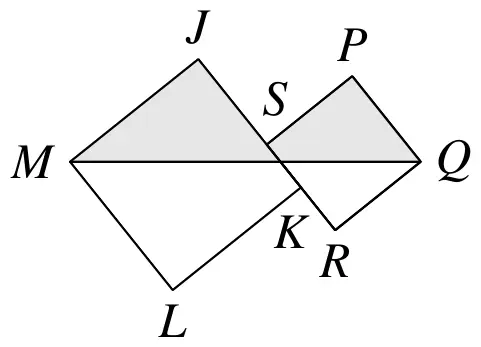
Junior Mathematical Challenge 2019, Question 23. © UK Mathematics Trust. Original paper on ukmt.org.uk
Answer: B 24 cm2
The diagram shows \(MJ\) produced and \(QP\) produced meeting at \(X\). Since \(MJ\) and \(QP\) are perpendicular to each other, \(\angle MXQ\) is a right angle. Similarly, \(ML\) produced and \(QR\) produced meet at \(Y\) and \(\angle QYM\) is a right angle. So \(MYQX\) is a rectangle. The length of the rectangle is \(MJ + JX = MJ + SP = (6 + 4)\) cm = 10 cm. As the vertex \(K\) is the midpoint of side \(RS\), then \(KR = (4 \div 2)\) cm = 2 cm. So the width of the rectangle is \(ML + LY = ML + KR = (6 + 2)\) cm = 8 cm. Also, \(JS = JK - SK = (6 - 2)\) cm = 4 cm. So \(SPXJ\) is a square of side 4 cm.
Hence the area of the shaded region is the area of triangle \(MXQ\) minus the area of square \(SPXJ\); that is, \((\tfrac{1}{2} \times 8 \times 10 - 4 \times 4)\) cm2 = 24 cm2.
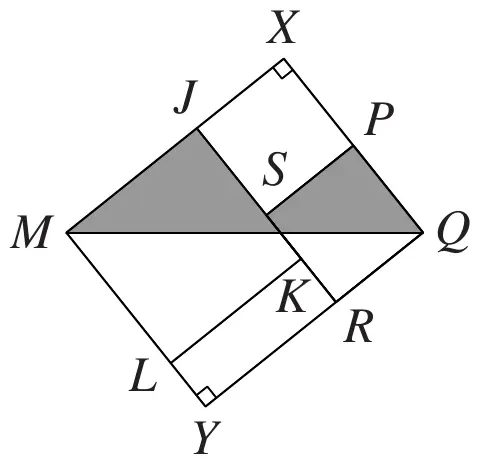
Solution © UK Mathematics Trust, from the JMC 2019 solutions. Longer versions with investigations: Solutions and investigations (PDF).