
May 2026 Paper 2 Q8
8. A and B are the points \((-2,11)\) and \((10,-13)\).
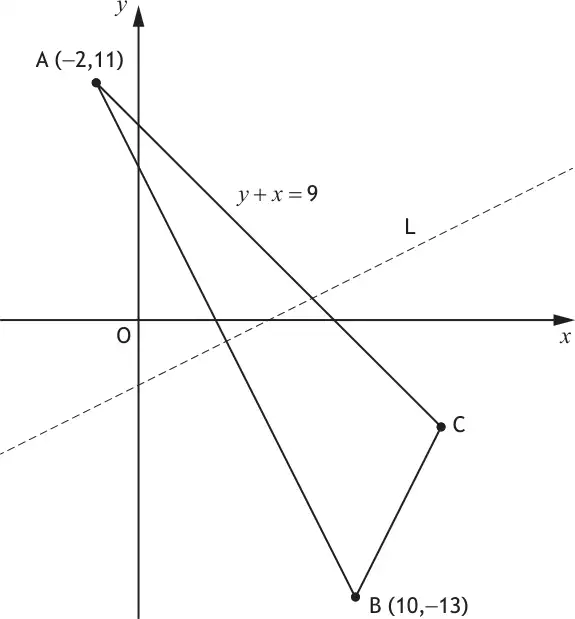
(a) Find the equation of L, the perpendicular bisector of AB. [4]
The equation of AC is \(y+x=9\).
(b) Calculate the size of the obtuse angle between L and AC. [2]
| Mark | Generic scheme | Illustrative scheme |
|---|---|---|
| •1 | find the midpoint of AB | \((4,-1)\) |
| •2 | calculate \(m_{\text{AB}}\) | \(-2\) |
| •3 | state perpendicular gradient | \(\dfrac{1}{2}\) |
| •4 | find equation of L | \(y=\dfrac{1}{2}x-3\) |
| (4) |
Notes:
- •4 is only available to candidates who find and use a perpendicular gradient and a midpoint.
- The gradient of the perpendicular bisector must appear in fully simplified form at •3 or •4 stage for •4 to be awarded - see Candidate A.
Commonly Observed Responses:
Candidate A - unsimplified gradient
| \(m=-\dfrac{24}{12}\) | •2 ✓ |
| \(m_\perp=\dfrac{12}{24}\) | •3 ✓ |
| \(24y=12x-72\) | •4 ^ |
Candidate B - using midpoint and \(m_{\text{AC}}\)
| \((4,-1)\) | •1 ✓ |
| \(m_{\text{AC}}=-1\) | •2 ✗ |
| \(m_\perp=1\) | •3 ✓1 |
| \(y=x-5\) | •4 ✓1 |
Candidate C
| \(m=-2=\dfrac{1}{2}\) | •2 ✓ •3 ✗ |
| \(y=\dfrac{1}{2}x-3\) | •4 ✓1 - BOD |
Candidate D
| \(m=-2\) | •2 ✓ |
| \(=\dfrac{1}{2}\) | •3 ✓ - BOD |
| \(y=\dfrac{1}{2}x-3\) | •4 ✓ |
| Mark | Generic scheme | Illustrative scheme |
|---|---|---|
| Method 1 | Method 1 | |
| •5 | calculate angle between one line and the \(x\)-axis | \(26.565\ldots^\circ\) OR \(135^\circ\) |
| •6 | calculate angle between second line and the \(x\)-axis AND calculate angle between L and AC | \(26.565\ldots^\circ\) OR \(135^\circ\) leading to \((135-26.565\ldots=)\ 108.434\ldots^\circ\) |
| Method 2 | Method 2 | |
| •5 | calculate one angle within small triangle | \(26.565\ldots^\circ\) OR \(45^\circ\) |
| •6 | calculate second angle within small triangle AND calculate angle between L and AC | \(26.565\ldots^\circ\) OR \(45^\circ\) leading to \((180-45-26.565\ldots=)\ 108.434\ldots^\circ\) |
| (2) |
Notes:
- Answers may be in radians: \(0.4636\ldots\), and \(\dfrac{3\pi}{4}\) \((2.356\ldots)\) leading to \(1.8925\ldots\) radians.
- Do not penalise the omission of units at •6.
- Accept any answers which round to \(108^\circ\) or 1.9 radians.
- For \(108^\circ\) without working award 0/2.
Commonly Observed Responses:
Candidate E - Incorrect working
| \(\tan^{-1}(-1)=45^\circ\) | •5 ✗ |
Candidate F - Incorrect working
| \(\tan(\theta)=-1\) \(\theta=45^\circ\) | •5 ✗ |
Candidate G - Poor notation
| \(m=-1\) \(m=\tan\theta\) \(\theta=\tan^{-1}(1)\) \(\theta=45\) \(\theta=180-45=135\) | •5 ✓ |
Candidate H - insufficient communication
| \(\theta=\tan^{-1}(1)\) \(\theta=45\) \(180-45=135\) | •5 ^ |
Candidate I - Using point of intersection, Pythagoras and right-angled trigonometry
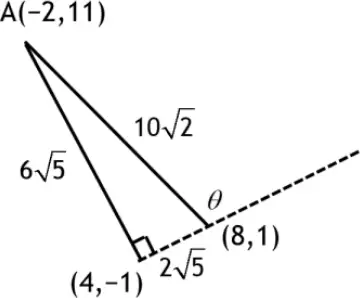 | •5 ✓ |
| \(\theta=180-\sin^{-1}\left(\dfrac{6\sqrt{5}}{10\sqrt{2}}\right)=108.4^\circ\) | •6 ✓ |
Only two of the distances are required in the diagram and other trig ratios may be used.
Candidate J - Representing gradients as vectors
| \(\mathbf{a}=\begin{pmatrix}2\\1\end{pmatrix},\ \mathbf{b}=\begin{pmatrix}-1\\1\end{pmatrix}\) | |
| \(\cos\theta=\dfrac{-1}{\sqrt{5}\sqrt{2}}\) | •5 ✓ |
| \(\theta=108.4^\circ\) | •6 ✓ |
Any multiples of the vectors may be used
Candidate K - Using a formula for angle between lines
| Acute angle between 2 lines = \(\tan^{-1}\left(\dfrac{m_1-m_2}{1+m_1m_2}\right)\) | |
| \(=\tan^{-1}\left(\dfrac{\frac{1}{2}-(-1)}{1+(-1)\left(\frac{1}{2}\right)}\right)\) | •5 ✓ |
| \(=\tan^{-1}(3)\) \(=71.6^\circ\) | |
| Obtuse angle = \(180-71.6=108.4^\circ\) | •6 ✓ |