
May 2023 Paper 2 Q1
1. Triangle PQR has vertices P(5, −1), Q(−2, 8) and R(13, 3).
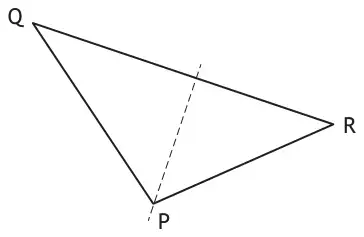
(a) Find the equation of the altitude from P. [3]
(b) Calculate the angle that the side PR makes with the positive direction of the \(x\)-axis. [2]
| Mark | Generic scheme | Illustrative scheme |
|---|---|---|
| •1 | find gradient of QR | \(-\dfrac{1}{3}\) or \(-\dfrac{5}{15}\) |
| •2 | use property of perpendicular lines | \(3\) |
| •3 | determine equation of altitude | \(y=3x-16\) |
| (3) |
Notes:
- •3 is only available to candidates who find and use a perpendicular gradient.
- The perpendicular gradient must appear in fully simplified form at •2 or •3 stage for •3 to be awarded - see Candidate B.
- •3 is not available as a consequence of using the midpoint of QR and the point P.
- At •3, accept any arrangement of a candidate’s equation where constant terms have been simplified.
Commonly Observed Responses:
Candidate A - BEWARE
Correct equation from incorrect substitution
| \(m=\dfrac{13-(-2)}{3-(8)}=3\) | •1 ✗ •2 ^ |
| \(y=3x-16\) | •3 ✗ |
Candidate B - unsimplified gradient
| \(m=-\dfrac{5}{15}\) | •1 ✓ |
| \(m_{\perp}=\dfrac{15}{5}\) | •2 ✓ |
| \(15x-5y-80=0\) | •3 ^ |
Corrected by Westie's Workshop
- The board's marking instructions printed “The gradient of the perpendicular bisector must appear”. Changed to “The perpendicular gradient must appear” because the question asks for the altitude from P, which is perpendicular to QR but is not a perpendicular bisector (it does not go through the midpoint of QR). Note 1 also talks about the perpendicular gradient.
Original: see the board's marking instructions PDF (link above).
| Mark | Generic scheme | Illustrative scheme |
|---|---|---|
| •4 | determine gradient of the line | \(m=\dfrac{1}{2}\) or \(\tan\theta=\dfrac{1}{2}\) |
| •5 | use \(m=\tan\theta\) to find the angle | \(26{\cdot}6^\circ\) or 0.4636… radians |
| (2) |
Notes:
- Do not penalise the omission of units at •5.
- Accept any answers which round to \(27^\circ\) or 0.46 radians.
- For \(27^\circ\) or 0.46 radians without working award 2/2.
- Where candidates find the angle of the altitude or other sides with the positive direction of the \(x\)-axis only •5 is available.
Commonly Observed Responses:
Candidate C - no reference to tan
| \(m=\dfrac{4}{8}\) | •4 ✓ |
| \(26.6^\circ\) | •5 ✓ |
Candidate D - BEWARE
| \(m=\dfrac{1}{2}\) | •4 ✓ |
| \(\theta=\tan\dfrac{1}{2}\) | •5 ✗ |
| \(\theta=26.6^\circ\) |
Stating \(\tan\) rather than \(\tan^{-1}\)
See general marking principle (g)
Candidate E
| \(\tan^{-1}(3)=72^\circ\) | •4 ✗ •5 ✓1 |