
May 2023 Paper 1 Q10
10.
(a) Show that \((x+5)\) is a factor of \(x^4+3x^3-7x^2+9x-30\). [2]
(b) Hence, or otherwise, solve \(x^4+3x^3-7x^2+9x-30=0\), \(x\in\mathbb{R}\). [5]
| Mark | Generic scheme | Illustrative scheme |
|---|---|---|
| •1 | use \(-5\) in synthetic division or evaluation of quartic | \(\begin{array}{r|rrrrr}-5&1&3&-7&9&-30\\&&&&&\\\hline&1&&&&\boxed{\phantom{0}}\end{array}\) or \((-5)^4+3\times(-5)^3-7\times(-5)^2\) \(+9\times(-5)-30\) |
| •2 | complete division/evaluation and interpret result | \(\begin{array}{r|rrrrr}-5&1&3&-7&9&-30\\&&-5&10&-15&30\\\hline&1&-2&3&-6&\boxed{0}\end{array}\) Remainder \(=0\ \therefore\ (x+5)\) is a factor OR \(f(-5)=0\ \therefore\ (x+5)\) is a factor |
| (2) |
Notes:
- Communication at •2 must be consistent with working at that stage i.e. a candidate’s working must arrive legitimately at 0 before •2 can be awarded.
- Accept any of the following for •2:
- ‘\(f(-5)=0\) so \((x+5)\) is a factor’
- ‘since remainder \(=0\), it is a factor’
- the ‘0’ from any method linked to the word ‘factor’ by ‘so’, ‘hence’, \(\therefore\), \(\rightarrow\), \(\Rightarrow\) etc.
- Do not accept any of the following for •2:
- double underlining the ‘0’ or boxing the ‘0’ without comment
- ‘\(x=-5\) is a factor’, ‘… is a root’
- the word ‘factor’ only, with no link.
Commonly Observed Responses:
Candidate A - grid method
| •1 ✓ | |||||||||||||||
| ||||||||||||||||
| with no remainder | ||||||||||||||||
| \(\therefore(x+5)\) is a factor | •2 ✓ |
Candidate B - grid method
| •1 ✓ | |||||||||||||||
| ||||||||||||||||
| \(\therefore(x+5)\left(x^3-2x^2+3x-6\right)=x^4+3x^3-7x^2+9x-30\) | ||||||||||||||||
| \(\therefore(x+5)\) is a factor | •2 ✓ |
| Mark | Generic scheme | Illustrative scheme |
|---|---|---|
| •3 | identify cubic and attempt to factorise | eg \(\begin{array}{r|rrrr}1&1&-2&3&-6\\&&1&-1&\\\hline&1&-1&&\boxed{\phantom{0}}\end{array}\) or \(\begin{array}{r|rrrr}2&1&-2&3&-6\\&&2&0&\\\hline&1&0&&\boxed{\phantom{0}}\end{array}\) |
| •4 | find second factor | \(\begin{array}{r|rrrr}2&1&-2&3&-6\\&&2&0&6\\\hline&1&0&3&\boxed{0}\end{array}\) leading to \((x-2)\) or \(x=2\) |
| •5 | identify quadratic | \(x^2+3\) |
| •6 | interpret lack of solutions of quadratic | \(b^2-4ac=-12<0\) \(\therefore\) no (further real) solutions OR \(x^2=-3\) or \(\xcancel{x^2=-3}\) \(\therefore\) no (further real) solutions |
| •7 | state solutions | \(x=-5,\ x=2\) |
| (5) |
Notes:
- Candidates who arrive at \((x+5)(x-2)\left(x^2+3\right)\) by using algebraic long division or by inspection gain •3, •4 and •5.
- Evidence for •6 may appear in the quadratic formula.
- At •6 accept interpretations such as “no further roots”, “no solutions” and “cannot factorise further” with justification.
- At •6 accept \(x=\sqrt{-3}\) leading to “not possible” and “not real”.
- Where there is no reference to \(b^2-4ac\) accept ‘\(-12<0\) so no real roots’ with the remaining roots stated for •6 - see candidates E and F.
- Do not accept any of the following for •6:
- \((x+5)(x-2)\left(x^2+3\right)\) no further roots/cannot factorise further.
- \((x+5)(x-2)(\ldots\ \ldots)(\ldots\ \ldots)\) no further roots/cannot factorise further.
- Where the quadratic factor obtained at •5 can be factorised, •6 and •7 are not available.
- •7 is only available where •6 has been awarded.
Commonly Observed Responses:
Candidate C
| \((x+5)(x-2)\left(x^2+3\right)\) | •5 ✓ |
| \(b^2-4ac=0-12<0\) so no solutions | •6 ✓ |
| \(x=-5,\ x=2\) | •7 ✓ |
Candidate D
| \((x+5)(x-2)\left(x^2+3\right)\) | •5 ✓ |
| \(b^2-4ac<0\) so no solutions | •6 ^ |
| \(x=-5,\ x=2\) | •7 ✓2 |
Candidate E
| \((x+5)(x-2)\left(x^2+3\right)\) | •5 ✓ |
| \(-12<0\) so no solutions | •6 ✓ |
| \(x=-5,\ x=2\) | •7 ✓ |
Candidate F
| \((x+5)(x-2)\left(x^2+3\right)\) | •5 ✓ |
| \(-12<0\) so no solutions | •6 ^ •7 ^ |
Candidate G - grid method
(a)
| ||||||||||||||||
| (b)
•3 is awarded for evidence of the cubic expression (which may be in the grid from part (a) ) AND the terms in the diagonal boxes summing to the second and third terms in the cubic respectively. | •3 ✓ | |||||||||||||||
| •4 ✓ | |||||||||||||||
| \((x+5)(x-2)\left(x^2+3\right)\) | •5 ✓ | |||||||||||||||
| \(b^2-4ac=-12<0\) \(\therefore\) no more solutions | •6 ✓ | |||||||||||||||
| \(x=-5,\ x=2\) | •7 ✓ |
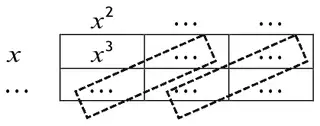
(In the marking instructions the column headings \(x^3\), \(-2x^2\), \(3x\), \(-6\) of the (a) grid are marked with a red dashed box.)