
May 2022 Paper 1 Q5
5. A line makes an angle of \(\dfrac{\pi}{3}\) radians with the \(y\)-axis, and passes through the point \((-2,0)\) as shown below.
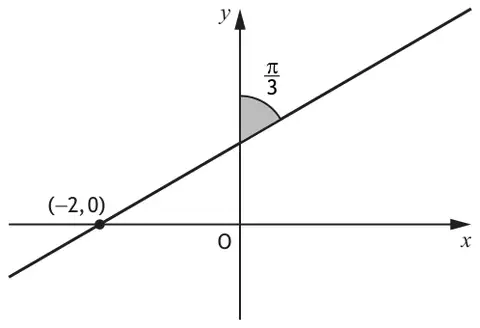
Determine the equation of the line. [3]
| Mark | Generic scheme | Illustrative scheme |
|---|---|---|
| •1 | use \(m=\tan\theta\) | \(m=\tan\dfrac{\pi}{6}\) or \(m=\tan30^\circ\) |
| •2 | evaluate exact value | \(\dfrac{1}{\sqrt{3}}\) |
| •3 | determine equation | eg \(y\sqrt{3}=x+2\) or \(y=\dfrac{1}{\sqrt{3}}x+\dfrac{2}{\sqrt{3}}\) |
| (3) |
Notes:
- Do not award •1 for \(m=\tan^{-1}\dfrac{\pi}{6}\). However •2 and •3 are still available. Where candidates state \(m=\tan^{-1}\dfrac{\pi}{3}\) only •3 is available.
- Where candidates make no reference to a trigonometric ratio or use an incorrect trigonometric ratio, •1 and •2 are unavailable.
- •3 is only available as a consequence of attempting to use a tan ratio. See Candidate F
- Accept \(y=\dfrac{1}{\sqrt{3}}(x+2)\) for •3, but do not accept \(y-0=\dfrac{1}{\sqrt{3}}(x+2)\).
Commonly Observed Responses:
Candidate A
| \(m=\tan\dfrac{\pi}{3}\) | •1 ✗ |
| \(m=\sqrt{3}\) | •2 ✓1 |
| \(y=\sqrt{3}x+2\sqrt{3}\) | •3 ✓1 |
Candidate B
| \(m=\dfrac{1}{\sqrt{3}}\) (with or without a diagram) | •1 ^ •2 ✓2 |
| \(y=\dfrac{1}{\sqrt{3}}x+\dfrac{2}{\sqrt{3}}\) | •3 ✓1 |
Candidate C
| \(m=\tan\theta\) (with or without a diagram) | •1 ^ |
| \(m=\dfrac{1}{\sqrt{3}}\) | •2 ✓1 |
Candidate D
| \(m=\tan\theta\) (with or without a diagram) | •1 ^ |
| \(m=\sqrt{3}\) | •2 ✗ |
| \(y=\sqrt{3}x+2\sqrt{3}\) | •3 ✓1 |
Candidate E
| \(m=\tan\theta=\dfrac{\pi}{6}\) | •1 ✗ |
| \(m=\dfrac{1}{\sqrt{3}}\) | •2 ✓1 |
Candidate F
| \(m=\tan\dfrac{\pi}{3}\) | •1 ✗ |
| \(m=60\) | •2 ✗ |
| \(y=60(x+2)\) | •3 ✗ |