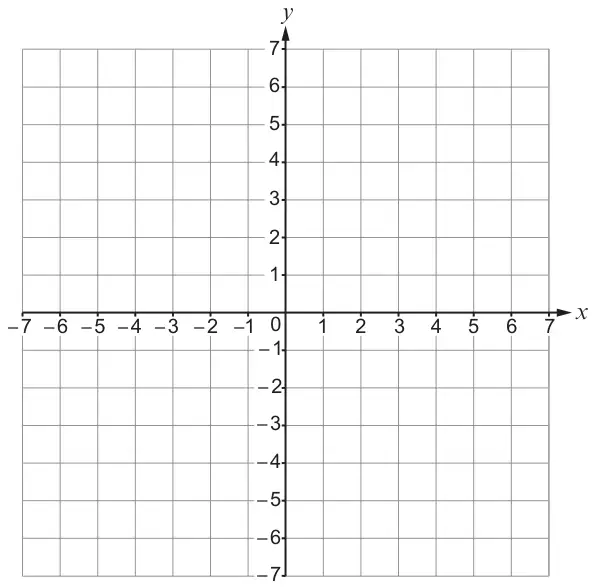
(a) The point \(O\) is the origin. The points \(O\), \(P\), and \(R\) are such that \(\mathbf{OP} = \begin{pmatrix}1\\3\end{pmatrix}\) and \(\mathbf{OR} = \begin{pmatrix}5\\-1\end{pmatrix}\).
(i) Find \(\mathbf{PR}\). [2] You may use this grid to help you.
(ii) The point \(Q\) is such that, when taken in a clockwise direction, the points \(O\), \(P\), \(Q\) and \(R\) form a parallelogram. Find \(\mathbf{OQ}\). [2] You may use the grid above to help you.
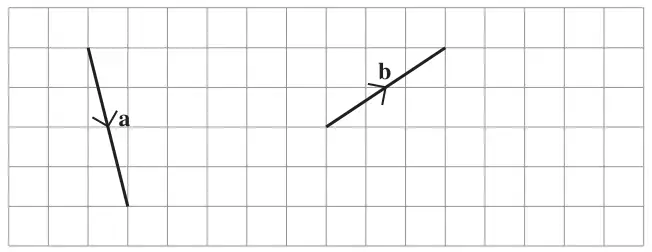
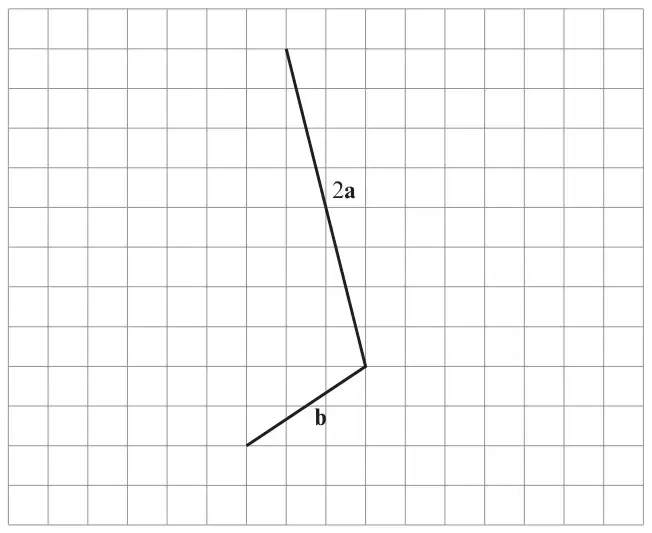
(b) The grid shows the vectors \(\mathbf{a}\) and \(\mathbf{b}\).Mitch wants to draw the vector \(2\mathbf{a} + \mathbf{b}\). His diagram is shown below.Make two criticisms of Mitch’s diagram. [2]
Mark scheme (a)
Scheme
Marks
Comments
(a)(i) Attempts \(\mathbf{OR} - \mathbf{OP}\)
S1
Evidence may be seen on grid
\(\begin{pmatrix}4\\-4\end{pmatrix}\) as final answer
B1
Not from wrong working
(a)(ii) Attempts \(\mathbf{OP} + \mathbf{OR}\)
S1
Evidence may be seen on grid
\(\begin{pmatrix}6\\2\end{pmatrix}\) as final answer
B1
If grid used, FT ‘their points P and R’ used consistently
Mark scheme (b)
Scheme
Marks
Comments
Two valid criticisms e.g. ‘The directions of the vectors are missing.’ and ‘b has been drawn in the wrong direction.’ or ‘The 2a has been drawn in the wrong direction.’ or ‘He has drawn 2a – b.’
We'd like to use Google Analytics cookies to count visits and see which pages help most. They're optional, and the site works exactly the same either way. Privacy policy