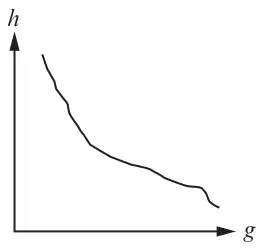
15. Pupils in a GCSE class have to perform two experiments.
(a) Jenny performs the first experiment. She sketches a graph of her results. She thinks the graph shows that the variable \(h\) is proportional to the cube root of the variable \(g\). Explain why Jenny cannot be correct. [1]
(b) Results of a second experiment show that there is a relationship between two positive variables \(p\) and \(q\). It has been found that \(p\) is inversely proportional to the square root of \(q\).
(i) When \(p = 36\), \(q = 25\). Write a formula for \(p\) in terms of \(q\). [3]
(ii) Use the formula to complete the table below. [2]
\(p\)
36
45
\(q\)
9
25
Mark scheme (a)
Scheme
Marks
Comments
Explanation to indicate that graph should show direct proportion. e.g.
the graph shows ‘as g increases, h decreases which is inverse proportion’
if h increases then the cube root of g will also increase
the graph shows inverse proportion
the graph is going down – it should be going up
E1
Allow: it is not a positive gradient
Do not allow:
graph should be a straight line
graph should be a smooth curve
h is bigger than g so h is bigger than \(\sqrt[3]{g}\)
when g increases h decreases without saying why
Mark scheme (b)
Scheme
Marks
Comments
(b)(i) \(p \propto \dfrac{1}{\sqrt{q}}\) OR \(p = \dfrac{k}{\sqrt{q}}\)
B1
Allow \(p \propto \dfrac{k}{\sqrt{q}}\)
\(k = 180\) OR \(k = 36\times\sqrt{25}\) OR \(k = 36\times5\) OR \(36 = \dfrac{k}{5}\)
M1
M1 implies B1 FT for B0 M1 A0 for \(p \propto \dfrac{1}{q^n}\) with \(n \gt 1\),
\((p=)\ \dfrac{180}{\sqrt{q}}\)
A1
May be seen explicitly in (b)(ii) Do not allow \(p \propto \dfrac{180}{\sqrt{q}}\)
(b)(ii)
\(p\)
60
36
45
\(q\)
9
25
16
B2
FT from inverse proportion but not from 1/q
B1 for each correct value
Check working space for unambiguous answers if table left blank
We'd like to use Google Analytics cookies to count visits and see which pages help most. They're optional, and the site works exactly the same either way. Privacy policy