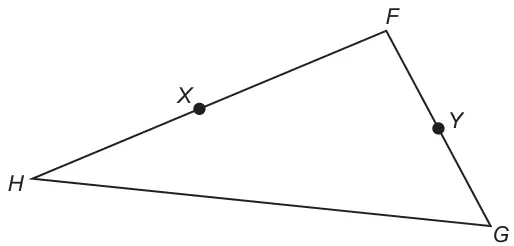
(a) The diagram shows triangle FGH. X is a point on FH where FX:XH = 3:2. Y is the midpoint of FG.
Diagram not drawn to scale
\(\mathbf{FX} = 9\mathbf{j}\) and \(\mathbf{GH} = 8\mathbf{k}\). Write the vector \(\mathbf{FY}\) in the form \(\mathrm{a}\mathbf{j} + \mathrm{b}\mathbf{k}\). [3]
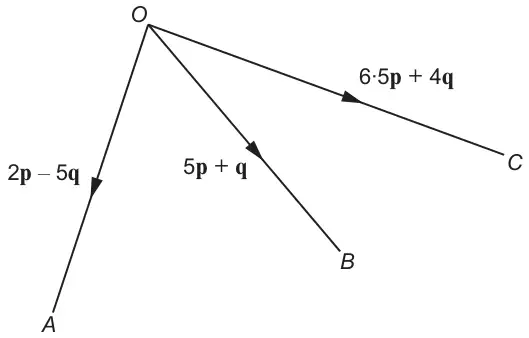
(b) The vectors \(\mathbf{OA}\), \(\mathbf{OB}\) and \(\mathbf{OC}\) are shown in the diagram.
Diagram not drawn to scale
Show that the points A, B and C lie on a straight line. [4]
Mark scheme (a)
Scheme
Marks
Comments
Sight or use of \(\mathbf{XH} = 6\mathbf{j}\) or \(\mathbf{FH} = 15\mathbf{j}\)
B1
May be seen in later work \(6\mathbf{j}\) or \(15\mathbf{j}\) alone on the diagram without a correct arrow is not sufficient for this B1
FT ‘their \(\mathbf{XH}\)’ or ‘their \(\mathbf{FH}\)’ provided \(\ne 9\mathbf{j}\)
\(7.5\mathbf{j} - 4\mathbf{k}\) or \(\frac{15}{2}\mathbf{j} - 4\mathbf{k}\)
A1
If only B1/B0 awarded award a further SC1 for \(-7.5\mathbf{j} + 4\mathbf{k}\)
Mark scheme (b)
Scheme
Marks
Comments
Accept candidate working with \(\mathbf{CA}\) instead of \(\mathbf{AC}\) etc throughout
Two of the following: \(\mathbf{AC} = -2\mathbf{p}+5\mathbf{q} + 6.5\mathbf{p}+4\mathbf{q}\ (= 4.5\mathbf{p} + 9\mathbf{q})\) \(\mathbf{BC} = -5\mathbf{p}-\mathbf{q} + 6.5\mathbf{p}+4\mathbf{q}\ (= 1.5\mathbf{p} + 3\mathbf{q})\) \(\mathbf{AB} = -2\mathbf{p}+5\mathbf{q} + 5\mathbf{p}+\mathbf{q}\ (3\mathbf{p} + 6\mathbf{q})\) Also \(\mathbf{OB} - \mathbf{OA}\) could represent \(\mathbf{AB}\) etc
M2
Ignore the third vector if found If not M2 award M1 for one of the following:
one correctly labelled vector
two correct vectors without labelling
Two of the following: \(\mathbf{AC} = 4.5\mathbf{p} + 9\mathbf{q}\) \(\mathbf{BC} = 1.5\mathbf{p} + 3\mathbf{q}\) \(\mathbf{AB} = 3\mathbf{p} + 6\mathbf{q}\) Also \(\mathbf{OB} - \mathbf{OA}\) could represent \(\mathbf{AB}\) etc
A1
FT from M2 only
Appropriate statement e.g. AC = 3BC or AC = -3CB (C is common) or AC = 1.5AB (and A is common) or AB = 2BC (and B is common) or AB is parallel to BC (and B is common)
E1
FT from any two correctly evaluated \(\mathbf{AC}\), \(\mathbf{AB}\), \(\mathbf{BC}\)
We'd like to use Google Analytics cookies to count visits and see which pages help most. They're optional, and the site works exactly the same either way. Privacy policy