
D1 June 2013 (R) Q8
8.
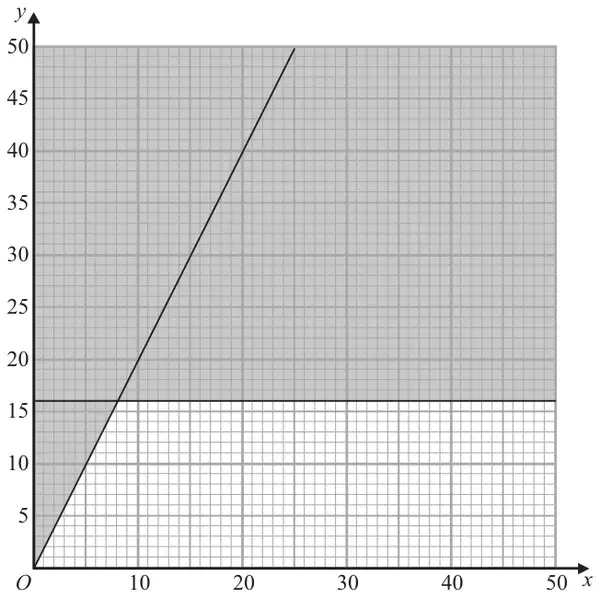
A company makes two types of garden bench, the ‘Rustic’ and the ‘Contemporary’. The company wishes to maximise its profit and decides to use linear programming.
Let \(x\) be the number of ‘Rustic’ benches made each week and \(y\) be the number of ‘Contemporary’ benches made each week.
The graph in Figure 6 is being used to solve this linear programming problem.
Two of the constraints have been drawn on the graph and the rejected region shaded out.
It takes 4 working hours to make one ‘Rustic’ bench and 3 working hours to make one ‘Contemporary’ bench. There are 120 working hours available in each week.
Market research shows that ‘Rustic’ benches should be at most \(\dfrac{3}{4}\) of the total benches made each week.
The profit on each ‘Rustic’ bench and each ‘Contemporary’ bench is £45 and £30 respectively.
| Scheme | Marks |
|---|---|
| \(y \leqslant 16\) ; and \(y \leqslant 2x\) | B1; M1 A1 |
| (3) |
Notes
a1B1 CAO for \(y \leqslant 16\)
a1M1 Coefficients correct, accept =, <, >, \(\leqslant\), \(\geqslant\) here
a1A1 CAO
| Scheme | Marks |
|---|---|
| \(4x + 3y \leqslant 120\) | M1 A1 |
| (2) |
Notes
b1M1 Coefficients correct and 120 accept =, <, >, \(\leqslant\), \(\geqslant\) here
b1A1 CAO
| Scheme | Marks |
|---|---|
| \(x \leqslant \frac{3}{4}(x + y)\) so \(4x \leqslant 3x + 3y\) so \(x \leqslant 3y\) | M1 A1 |
| (2) |
Notes
c1M1 Accept non-integer coefficients here, accept =, <, >, \(\leqslant\), \(\geqslant\) here, coefficients correct.
c1A1 CAO must be integer coefficients.
| Scheme | Marks |
|---|---|
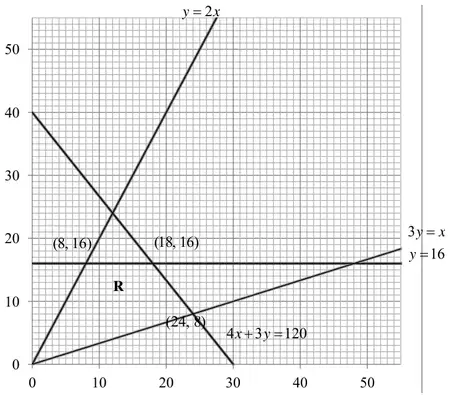 | |
| The correct two lines (\(4x + 3y = 120\), \(x = 3y\)) | B1 B1 |
| R labelled correctly | B1 |
| (3) |
Notes
d1B1 \(4x + 3y = 120\) correctly drawn. The line must pass within one small square of the point (18, 16) and if line extended must go from axis to axis through the points of intersection with the axes within one small square. The line must be long enough to form the feasible region. Check using measurement tool if required. Ignore shading.
d2B1 \(x = 3y\) correctly drawn. The line must pass within one small square of the origin and the point (24, 8). The line must be long enough to form the feasible region. Ignore shading.
d3B1 R labelled (not just implied by shading) – must have scored the first two marks in this part.
| Scheme | Marks |
|---|---|
| (P = ) \(45x + 30y\) | B1 |
| (1) |
Notes
e1B1 CAO (isw if (P =) \(45x + 30y\) is simplified to \(k(45x + 30y)\) but if \(45x + 30y\) not stated then B0)
| Scheme | Marks |
|---|---|
| At (0,0) P = 0 | M1 |
| At (8, 16) P = 840 | A1 (any 2) |
| At (18, 16) P = 1 290 | A1 (any 3) |
| At (24, 8) P = 1 320 | A1 (all 4) |
| (4) |
Notes
f1M1 At least two of their, or the correct R vertices found (either by reading off their graph or using simultaneous equations) and tested using their P. Objective line method (only) is M0.
f1A1 Two vertices found and tested correctly CAO (must be using two of the correct vertices and the values for P must be correct).
f2A1 Three vertices found and tested correctly CAO (must be using three of the correct vertices and the values for P must be correct).
f3A1 All four vertices found and tested correctly CAO (all values of P must be correct).
The mark scheme prints one total of (5) for parts (f) and (g) together.
| Scheme | Marks |
|---|---|
| So optimal point is (24, 8) giving (£)1 320 | B1 |
| (1) | |
| (16 marks) |
Notes
g1B1 CAO for profit (condone lack of £)