
D1 January 2006 Q6
6. A company produces two types of party bag, Infant and Junior. Both types of bag contain a balloon, a toy and a whistle. In addition the Infant bag contains 3 sweets and 3 stickers and the Junior bag contains 10 sweets and 2 stickers.
The sweets and stickers are produced in the company’s factory. The factory can produce up to 3000 sweets per hour and 1200 stickers per hour. The company buys a large supply of balloons, toys and whistles.
Market research indicates that at least twice as many Infant bags as Junior bags should be produced.
Both types of party bag are sold at a profit of 15p per bag. All the bags are sold.
The company wishes to maximise its profit.
Let \(x\) be the number of Infant bags produced and \(y\) be the number of Junior bags produced per hour.
In order to increase the profit further, the company decides to buy additional equipment. It can buy equipment to increase the production of either sweets or stickers, but not both.
The manager of the company does not understand why the balloons, toys and whistles have not been considered in the above calculations.
| Scheme | Marks |
|---|---|
| Maximise, \((P =)\ 15x + 15y\) | B1, B1 |
| subject to \(\quad 3x + 10y \leqslant 3000\) \(\phantom{\text{subject to}\quad} 3x + 2y \leqslant 1200\) \(\phantom{\text{subject to}\quad} x \geqslant 2y\) \(\phantom{\text{subject to}\quad} x, y \geqslant 0\) | B3,2,1,0 |
| (5) |
| Scheme | Marks |
|---|---|
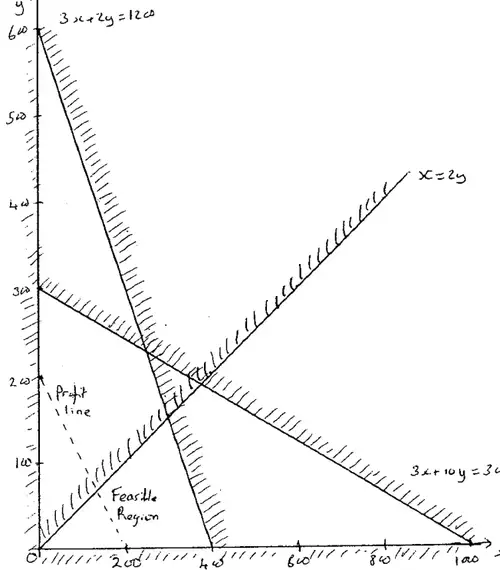 | B6,5,4,3,2,1,0 |
| (6) |
| Scheme | Marks |
|---|---|
| Profit line or vertex testing, \((300, 150)\), profit \(=\) £67.50 | M1 A1ft A1ft |
| (3) |
| Scheme | Marks |
|---|---|
| Production of stickers should be increased since this would move the intersection point further from the origin. | B2,1ft,0 |
| (2) |
| Scheme | Marks |
|---|---|
| e.g. The constraint lines would be far outside the feasible region – so they would not affect it. | B2,1,0 |
| (2) | |
| (18 marks) |