
D1 June 2011 Q3
3.
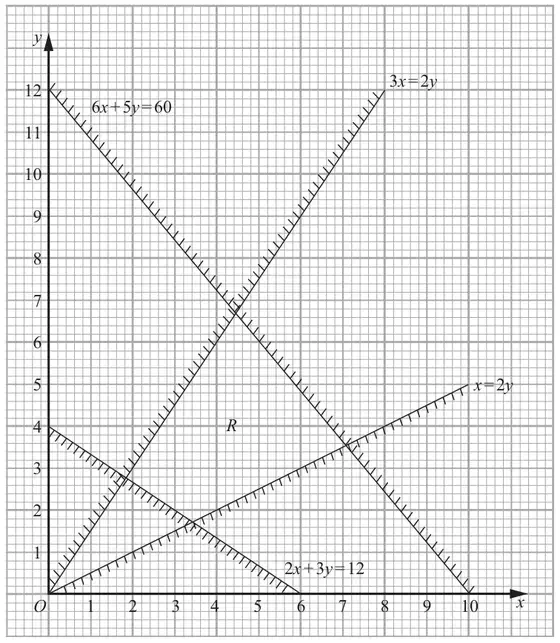
Figure 2 shows the constraints of a linear programming problem in \(x\) and \(y\), where \(R\) is the feasible region.
The objective is to maximise \(3x + y\).
Given that integer values of \(x\) and \(y\) are now required,
| Scheme | Marks |
|---|---|
| \(6x + 5y \leqslant 60\) \(2x + 3y \geqslant 12\) \(3x \geqslant 2y\) \(x \leqslant 2y\) | B2,1,0 |
| (2) |
Notes
(a)1B1 Any two inequalities correct, accept < and > here (but not = of course).
2B1 All four correct. Must be \(\leqslant\) and \(\geqslant\) here
| Scheme | Marks |
|---|---|
| Drawing objective line{ (0,3) (1,0)} Testing at least 2 points | M1 A1 |
| Calculating optimal point Testing at least 3 points | DM1 |
| \(\left(7\dfrac{1}{17}, 3\dfrac{9}{17}\right) = \left(\dfrac{120}{17}, \dfrac{60}{17}\right) \approx (7.06, 3.53)\) | A1 awrt |
| (4) |
Notes
\[\begin{aligned}&\left(3\tfrac{3}{7}, 1\tfrac{5}{7}\right) = \left(\tfrac{24}{7}, \tfrac{12}{7}\right) \approx (3.43, 1.71) \rightarrow 12\\ &\left(1\tfrac{11}{13}, 2\tfrac{10}{13}\right) = \left(\tfrac{24}{13}, \tfrac{36}{13}\right) \approx (1.85, 2.77) \rightarrow 8.307692\ \left(8\tfrac{4}{13} = \tfrac{108}{13}\right)\\ &\left(4\tfrac{4}{9}, 6\tfrac{2}{3}\right) = \left(\tfrac{40}{9}, \tfrac{20}{3}\right) \approx (4.44, 6.67) \rightarrow 20\\ &\left(7\tfrac{1}{17}, 3\tfrac{9}{17}\right) = \left(\tfrac{120}{17}, \tfrac{60}{17}\right) \approx (7.06, 3.53) \rightarrow 24.705882\ \left(24\tfrac{12}{17} = \tfrac{420}{17}\right)\end{aligned}\](b)1M1 Drawing objective line or its reciprocal OR testing two vertices in the feasible region (see list above) points correct to 1 dp.
1A1 Correct objective line OR two points correctly tested (1 dp ok)
2DM1 Calculating optimal point either answer to 2 dp or better or using S.E’s (correct 2 equations for their point + attempt to eliminate one variable.); OR Testing three points correctly and optimal one to 2dp.
2A1 CAO 2 dp or better.
| Scheme | Marks |
|---|---|
| \(24\dfrac{12}{17} = \dfrac{420}{17} \approx 24.7\) (awrt) | B1 |
| (1) |
Notes
(c)B1 CAO
(Corrected from the printed mark scheme: the scheme prints \(\dfrac{240}{17}\); \(24\dfrac{12}{17} = \dfrac{420}{17}\), as in the list of points above.)
| Scheme | Marks |
|---|---|
| (6,4) | B1 |
| (1) | |
| (8 marks) |
Notes
(d)B1 CAO not (4,6).