
D1 January 2008 Q1
1.
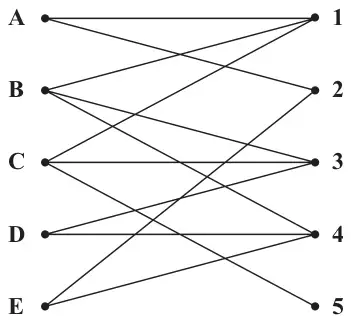
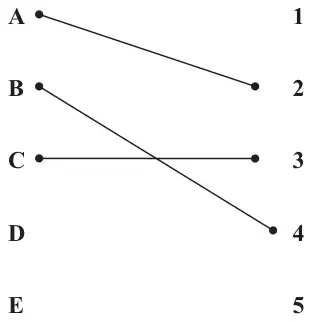
At a school fair, five teachers, \(A\), \(B\), \(C\), \(D\) and \(E\), are to supervise five stalls, 1, 2, 3, 4 and 5.
A bipartite graph showing their possible allocations is given in Figure 1. An initial matching is given in Figure 2.
List clearly the alternating paths you use. (5)
| Scheme | Marks |
|---|---|
| (i) A path from an unmatched vertex in one set to an unmatched vertex in the other set … | B1 |
| … which alternately uses arcs not in / in the matching. | B1 |
| (2) | |
| (ii) A one-to-one pairing of | B1 |
| some elements of one set with the other set | B1 |
| (2) |
Notes
i 1B1 Unmatched to unmatched
2B1 Alternate arcs not in/in [not vertices/nodes, not ‘zigzag’]
ii 3B1 One – to- one
4B1 Elements of one set with elements of the other.
| Scheme | Marks |
|---|---|
| e.g. D – 3 = C – 5 change status D = 3 – C = 5 | M1 A1 |
| E – 2 = A – 1 change status E = 2 – A = 1 | M1 A1 |
| A = 1 B = 4 C = 5 D = 3 E = 2 | A1 |
| (5) | |
| (9 marks) |
Notes
(b) 1M1 ‘Path’ starting at D or E, finishing at 1 or 5 – or vice versa.
1A1 A correct path – including change status.
2M1 ‘Path’ from remaining unmatched (D/E) to unmatched (1/5) or v.v.
2A1 A second correct path – incl. c.s, but don’t’ penalise c.s. twice.
3A1 Complete matching, must follow through from two correct paths.
Possible alternating paths and matchings
| Path 1 | Path 2 | A | B | C | D | E |
|---|---|---|---|---|---|---|
| D-3-C-1 | E-2-A-1-C-5 | 1 | 4 | 5 | 3 | 2 |
| D-3-C-1 | E-4-B-1-C-5 | 2 | 1 | 5 | 3 | 4 |
| D-3-C-5 | E-2-A-1 | 1 | 4 | 5 | 3 | 2 |
| D-3-C-5 | E-4-B-1 | 2 | 1 | 5 | 3 | 4 |
| D-3-C-4-B-1 | E-2-A-1-B-3-D-4-C-5 | 1 | 3 | 5 | 4 | 2 |
| D-3-C-4-B-1 | E-2-A-1-B-4-C-5 | 1 | 4 | 5 | 3 | 2 |
| D-3-C-4-B-1 | E-4-C-5 | 2 | 1 | 5 | 3 | 4 |
| D-4-B-1 | E-2-A-1-B-3-C-5 | 1 | 3 | 5 | 4 | 2 |
| D-4-B-1 | E-2-A-1-B-4-D-3-C-5 | 1 | 4 | 5 | 3 | 2 |
| D-4-B-1 | E-4-D-3-C-5 | 2 | 1 | 5 | 3 | 4 |
| D-4-B-3-C-1 | E-2-A-1-C-5 | 1 | 3 | 5 | 4 | 2 |
| D-4-B-3-C-1 | E-4-D-3-B-1-C-5 | 2 | 1 | 5 | 3 | 4 |
| D-4-B-3-C-5 | E-2-A-1 | 1 | 3 | 5 | 4 | 2 |
| D-4-B-3-C-5 | E-4-D-3-B-1 | 2 | 1 | 5 | 3 | 4 |
| E-2-A-1 | D-3-C-5 | 1 | 4 | 5 | 3 | 2 |
| E-2-A-1 | D-4-B-3-C-5 | 1 | 3 | 5 | 4 | 2 |
| E-4-B-1 | D-3-C-5 | 2 | 1 | 5 | 3 | 4 |
| E-4-B-1 | D-4-E-2-A-1-B-3-C-5 | 1 | 3 | 5 | 4 | 2 |
| E-4-B-3-C-1 | D-3-B-1-C-5 | 2 | 1 | 5 | 3 | 4 |
| E-4-B-3-C-1 | D-3-B-4-E-2-A-1-C-5 | 1 | 4 | 5 | 3 | 2 |
| E-4-B-3-C-1 | D-4-E-2-A-1-C-5 | 1 | 3 | 5 | 4 | 2 |
| E-4-B-3-C-5 | D-3-B-1 | 2 | 1 | 5 | 3 | 4 |
| E-4-B-3-C-5 | D-3-B-4-E-2-A-1 | 1 | 4 | 5 | 3 | 2 |
| E-4-B-3-C-5 | D-4-E-2-A-1 | 1 | 3 | 5 | 4 | 2 |
(Corrected from the printed mark scheme: for Path 1 D-4-B-1 with Path 2 E-2-A-1-B-3-C-5 the matching is printed as A = 1, B = 4, C = 5, D = 3, E = 2; these paths give A = 1, B = 3, C = 5, D = 4, E = 2.)