
FP2 June 2013 Q5
5.
| Scheme | Marks |
|---|---|
| \(\dfrac{\mathrm{d}y}{\mathrm{d}x} + 2\dfrac{y}{x} = 4x\) | M1 |
| I F: \(\mathrm{e}^{\int\frac{2}{x}\mathrm{d}x} = \mathrm{e}^{2\ln x} = \left(x^2\right)\) | M1 |
| \(x^2\dfrac{\mathrm{d}y}{\mathrm{d}x} + 2xy = 4x^3\) | M1dep |
| \(yx^2 = \displaystyle\int 4x^3\,\mathrm{d}x = x^4\ (+c)\) | M1dep |
| \(y = x^2 + \dfrac{c}{x^2}\) | A1cso |
| (5) |
Notes
M1 for dividing the given equation by \(x\). May be implied by subsequent work.
M1 for IF \(= \mathrm{e}^{\int\frac{2}{x}\mathrm{d}x} = \mathrm{e}^{2\ln x} = \left(x^2\right)\). \(\displaystyle\int\dfrac{2}{x}\,\mathrm{d}x\) must be seen together with an attempt at integrating this. \(\ln x\) must be seen in the integrated function.
M1dep for multiplying the equation \(\dfrac{\mathrm{d}y}{\mathrm{d}x} + 2\dfrac{y}{x} = 4x\) by their IF, dep on 2nd M mark
M1dep for attempting the integration of the resulting equation – constant not needed. Dep on 2nd and 3rd M marks
A1cso for \(y = x^2 + \dfrac{c}{x^2}\) oe eg \(yx^2 = x^4 + c\)
Alternative: for first three marks: Multiply given equation by \(x\) to get straight to the third line. All 3 M marks should be given.
| Scheme | Marks |
|---|---|
| \(x = 1,\ y = 5 \Rightarrow c = 4\) | M1 |
| \(y = x^2 + \dfrac{4}{x^2}\) | A1ft |
| (2) |
Notes
M1 for using \(x = 1,\ y = 5\) in their expression for \(y\) to obtain a value for \(c\)
A1ft for \(y = x^2 + \dfrac{4}{x^2}\) follow through their result from (a)
| Scheme | Marks |
|---|---|
| \(\dfrac{\mathrm{d}y}{\mathrm{d}x} = 2x - \dfrac{8}{x^3}\) | |
| \(\dfrac{\mathrm{d}y}{\mathrm{d}x} = 0\quad x^4 = 4,\ x = \pm\sqrt{2}\) or \(\pm\sqrt[4]{4}\) | M1,A1 |
| \(y = 2 + \dfrac{4}{2} = 4\) | A1cao |
| Alt: Complete square on \(y = \ldots\) or use the original differential equation | M1 |
| \(x = \pm\sqrt{2},\quad y = 4\) | A1,A1 |
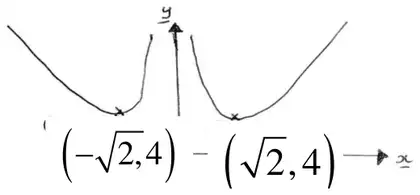 | B1 shape B1 turning points shown somewhere |
| (5) | |
| (12 marks) |
Notes
M1 for differentiating their result from (b), equating to 0 and solving for \(x\)
A1 for \(x = \pm\sqrt{2}\) (no follow through) or \(\pm\sqrt[4]{4}\). No extra real values allowed but ignore any imaginary roots shown.
A1cao for using the particular solution to obtain \(y = 4\). No extra values allowed.
Alternatives for these 3 marks:
M1 for making \(\dfrac{\mathrm{d}y}{\mathrm{d}x} = 0\) in the given differential equation to get \(y = 2x^2\) and using this with their particular solution to obtain an equation in one variable
OR complete the square on their particular solution to get \(y = \left(x + \dfrac{2}{x}\right)^2 - 4\)
A1 for \(x = \pm\sqrt{2}\) (no follow through)
A1cao for \(y = 4\). No extra values allowed
B1 for the correct shape – must have two minimum points and two branches, both asymptotic to the \(y\)-axis
B1 for a fully correct sketch with the coordinates of the minimum points shown somewhere on or beside the sketch. Decimals accepted here.