
M4 June 2015 Q6
6.
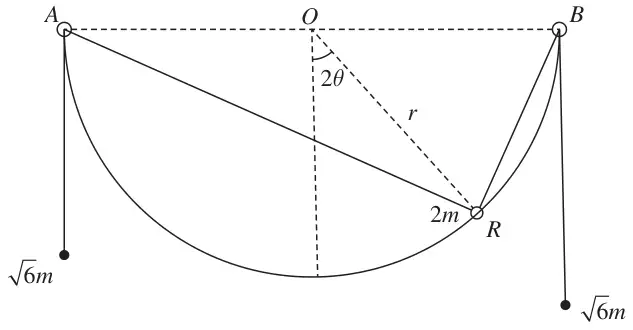
A smooth wire, with ends \(A\) and \(B\), is in the shape of a semicircle of radius \(r\). The line \(AB\) is horizontal and the midpoint of \(AB\) is \(O\). The wire is fixed in a vertical plane. A small ring \(R\) of mass \(2m\) is threaded on the wire and is attached to two light inextensible strings. One string passes through a small smooth ring fixed at \(A\) and is attached to a particle of mass \(\sqrt{6}m\). The other string passes through a small smooth ring fixed at \(B\) and is attached to a second particle of mass \(\sqrt{6}m\). The particles hang freely under gravity, as shown in Figure 3. The angle between the radius \(OR\) and the downward vertical is \(2\theta\), where \(-\dfrac{\pi}{4} < \theta < \dfrac{\pi}{4}\)
| Scheme | Marks |
|---|---|
| GPE of the ring: \(-2mgr\cos 2\theta\) | B1 |
| GPE of suspended particles: \(-\sqrt{6}mg(L_1 - a) - \sqrt{6}mg(L_2 - b)\) | M1 |
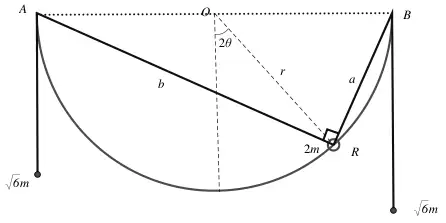
| \(a = 2r\sin(45 - \theta) = \dfrac{2r}{\sqrt{2}}(\cos\theta - \sin\theta)\) | A1 |
| \(b = 2r\cos(45 - \theta) = \dfrac{2r}{\sqrt{2}}(\cos\theta + \sin\theta)\) | A1 |
| GPE of system: \(-\sqrt{6}mg(L_1 - a) - \sqrt{6}mg(L_2 - b) - 2mgr\cos 2\theta\) | DM1 |
| \(= 2 \times \dfrac{2r}{\sqrt{2}}\cos\theta \times \sqrt{6}mg - 2mgr\cos 2\theta\) + constant | |
| \(= 2mgr\left(2\sqrt{3}\cos\theta - \cos 2\theta\right) +\) constant | A1 |
| (6) |
Notes
M1 Expression of the correct structure involving their \(L_1\), \(L_2\), \(a\) and \(b\)
A1 Correct expression for \(BR\) in terms of \(r\) and \(\theta\). Accept \(r\sqrt{2(1 - \sin 2\theta)}\)
A1 Correct expression for \(AR\) in terms of \(r\) and \(\theta\). Accept \(r\sqrt{2(1 + \sin 2\theta)}\)
DM1 Add the three components. Dependent on the previous M
A1 Simplify to the given answer
| Scheme | Marks |
|---|---|
| \(\dfrac{\mathrm{d}V}{\mathrm{d}\theta} = -4\sqrt{3}\,mgr\sin\theta + 4mgr\sin 2\theta\) | M1 |
| In equilibrium: \(\dfrac{\mathrm{d}V}{\mathrm{d}\theta} = 0 = 4mgr\sin\theta\left(-\sqrt{3} + 2\cos\theta\right)\) | M1 |
| \(\theta = \pm\cos^{-1}\left(\dfrac{\sqrt{3}}{2}\right) = \pm\dfrac{\pi}{6}\ (= \pm 0.52)\) | A1 |
| or \(\theta = 0\) | B1 |
| (4) |
Notes
M1 Differentiate
M1 Set \(\dfrac{\mathrm{d}V}{\mathrm{d}\theta} = 0\) and solve for \(\theta\)
(Corrected from the printed mark scheme: the first term of \(\frac{\mathrm{d}V}{\mathrm{d}\theta}\) is printed as \(-4\sqrt{3}\,mgr\) in \(\theta\).)
| Scheme | Marks |
|---|---|
| \(\dfrac{\mathrm{d}^2V}{\mathrm{d}\theta^2} = -4\sqrt{3}mgr\cos\theta + 8mgr\left(\cos^2\theta - \sin^2\theta\right)\) | M1 |
| \(\dfrac{\mathrm{d}^2V}{\mathrm{d}\theta^2} = mgr\left(-4\sqrt{3} \times \dfrac{\sqrt{3}}{2} + 8\left(\dfrac{3}{4} - \dfrac{1}{4}\right)\right) = -2mgr < 0\) | M1 |
| So equilibrium is unstable | A1 |
| (3) | |
| (13 marks) |
Notes
M1 Second derivative - needs to be the full expression.
M1 Substitute \(\theta = \dfrac{\pi}{6}\)
A1 No errors seen
(Corrected from the printed mark scheme: the bracket is printed as \(8\left(\frac{3}{4} - \frac{1}{2}\right)\); \(\sin^2\frac{\pi}{6} = \frac{1}{4}\), which gives the printed \(-2mgr\).)