
M4 June 2010 Q5
5.
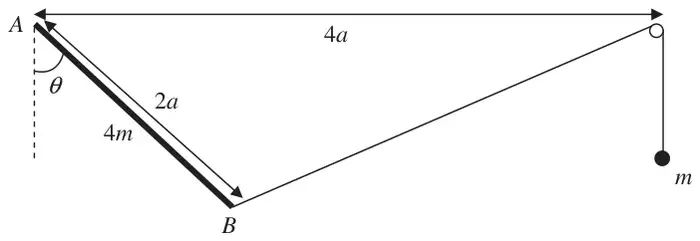
The end \(A\) of a uniform rod \(AB\), of length \(2a\) and mass \(4m\), is smoothly hinged to a fixed point. The end \(B\) is attached to one end of a light inextensible string which passes over a small smooth pulley, fixed at the same level as \(A\). The distance from \(A\) to the pulley is \(4a\). The other end of the string carries a particle of mass \(m\) which hangs freely, vertically below the pulley, with the string taut. The angle between the rod and the downward vertical is \(\theta\), where \(0 \lt \theta \lt \frac{\pi}{2}\), as shown in Figure 1.
(a) Show that the potential energy of the system is\[2mga(\sqrt{(5 - 4\sin\theta)} - 2\cos\theta) + \text{constant}.\] (5)
(b) Hence, or otherwise, show that any value of \(\theta\) which corresponds to a position of equilibrium of the system satisfies the equation\[4\sin^3\theta - 6\sin^2\theta + 1 = 0.\] (5)
(c) Given that \(\theta = \frac{\pi}{6}\) corresponds to a position of equilibrium, determine its stability. (5)
| Scheme | Marks |
|---|---|
| \(\sqrt{4a^2 + 16a^2 - 16a^2\sin\theta}\) | M1 A1 |
| Let length of string be \(L\). | |
| \(V = -4mga\cos\theta - mg(L - \sqrt{4a^2 + 16a^2 - 16a^2\sin\theta}\) | M1 A1 |
| \(= -4mga\cos\theta - mgL + 2mga\sqrt{5 - 4\sin\theta}\) | |
| \(= 2mga\left\{\sqrt{5 - 4\sin\theta} - 2\cos\theta\right\} + \text{constant}\quad **\) | A1 |
| (5) |
| Scheme | Marks |
|---|---|
| \(V'(\theta) = 2mga\left\{\dfrac{-2\cos\theta}{\sqrt{5 - 4\sin\theta}} + 2\sin\theta\right\}\) | M1 A1 |
| For equilibrium, \(V'(\theta) = 0\) | |
| \(\left\{\dfrac{-2\cos\theta}{\sqrt{5 - 4\sin\theta}} + 2\sin\theta\right\} = 0\) | M1 |
| \(\dfrac{\cos^2\theta}{5 - 4\sin\theta} = \sin^2\theta\) | |
| \(1 - \sin^2\theta = \sin^2\theta(5 - 4\sin\theta)\) | DM1 |
| \(4\sin^3\theta - 6\sin^2\theta + 1 = 0\quad **\) | A1 |
| (5) |
| Scheme | Marks |
|---|---|
| \(V''(\theta) = 2mga\left(\dfrac{\left\{\sqrt{5 - 4\sin\theta}.2\sin\theta - \dfrac{-2\cos\theta.(-4\cos\theta)}{2\sqrt{5 - 4\sin\theta}}\right\}}{(5 - 4\sin\theta)} + 2\cos\theta\right)\) | M1 A1 A1 |
| \(V''\left(\dfrac{\pi}{6}\right) = 2mga\left\{\dfrac{\sqrt{3} - \dfrac{8 \times \frac{3}{4}}{2\sqrt{3}}}{3} + \sqrt{3}\right\} = 2mga\sqrt{3} \gt 0\) so stable | DM1 A1 |
| (5) | |
| (15 marks) |