
M4 June 2007 Q6
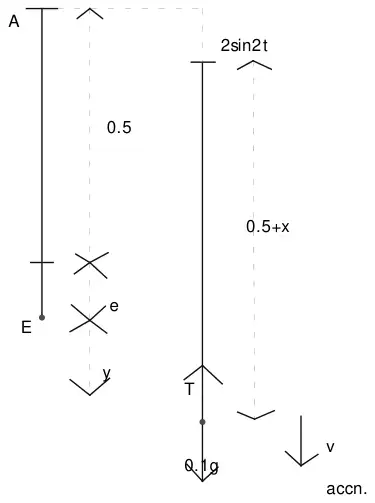
6. A small ball is attached to one end of a spring. The ball is modelled as a particle of mass 0.1 kg and the spring is modelled as a light elastic spring \(AB\), of natural length 0.5 m and modulus of elasticity 2.45 N. The particle is attached to the end \(B\) of the spring. Initially, at time \(t = 0\), the end \(A\) is held at rest and the particle hangs at rest in equilibrium below \(A\) at the point \(E\). The end \(A\) then begins to move along the line of the spring in such a way that, at time \(t\) seconds, \(t \leqslant 1\), the downward displacement of \(A\) from its initial position is \(2\sin 2t\) metres. At time \(t\) seconds, the extension of the spring is \(x\) metres and the displacement of the particle below \(E\) is \(y\) metres.
Given that \(y = \dfrac{98}{45}\sin 2t\) is a particular integral of this differential equation,
| Scheme | Marks |
|---|---|
| At E, \(\ \dfrac{2.45e}{0.5} = 0.1g\) | M1 |
| \(\Rightarrow e = 0.2\) | A1 |
| \(\Rightarrow 0.5(orl) + 0.2 + y = 2\sin 2t + 0.5(orl) + x\) | |
| \(\Rightarrow 0.2 + y = 2\sin 2t + x\ \ *\) | B1 |
| (3) |
Notes
M1 Hooke’s law to find extension at equilibrium
A1 cao
B1 Q specifies reference to a diagram. Correct reasoning leading to given answer.
| Scheme | Marks |
|---|---|
| R\((\downarrow)\) \(\quad 0.1g - T = 0.1\ddot{y}\) | M*1 |
| \(0.1g - \dfrac{2.45x}{0.5} = 0.1\ddot{y}\) | M1 |
| \(0.98 - 4.9(0.2 + y - 2\sin 2t) = 0.1\ddot{y}\) | DM*1A1 |
| \(\left(-4.9y + 9.8\sin 2t = 0.1\ddot{y}\right)\) | |
| \(\Rightarrow \dfrac{d^2y}{dt^2} + 49y = 98\sin 2t\ \ *\) | A1 cso |
| (5) |
Notes
M1 Use of F=ma. Weight, tension and acceleration. Condone sign errors.
M1 Substitute for tension in terms of \(x\)
M1 Use given result to substitute for \(x\) in terms of \(y\)
A1 Correct unsimplified equation
A1 Rearrange to given form cso.
| Scheme | Marks |
|---|---|
| CF is \(\ y = A\cos 7t + B\sin 7t\) | M1 |
| Hence GS is \(\ y = A\cos 7t + B\sin 7t + \dfrac{98}{45}\sin 2t\) | A1 |
| t = 0, y = o: \(\quad 0 = A\quad\) so, \(\ y = B\sin 7t + \dfrac{98}{45}\sin 2t\) | B1 |
| \(\dot{y} = 7B\cos 7t + \dfrac{196}{45}\cos 2t\) | M1 |
| t = 0, \(\dot{y} = 0\colon\ 0 = 7B + \dfrac{196}{45}\qquad \Rightarrow B = -\dfrac{28}{45}\) | |
| \(\Rightarrow y = \dfrac{14}{45}(7\sin 2t - 2\sin 7t)\) | A1 |
| (5) |
Notes
M1 Correct form for CF
A1 GS for y correct
B1 Deduce coefficient of cos \(\theta\) = 0
M1 Differentiate their y and substitue t=0, \(\dot{y} = 0\)
A1 y in terms of t. Any exact equivalent.
| Scheme | Marks |
|---|---|
| \(\dot{y} = \dfrac{14}{45}(14\cos 2t - 14\cos 7t)\) | B1 |
| \(\dot{y} = 0 \Rightarrow \cos 2t = \cos 7t\) | M1 |
| \(\Rightarrow 7t = 2k\pi \pm 2t\) | M1 |
| \(k = 1 \Rightarrow 9t = 2\pi\quad (\text{or } 5t = 2\pi)\) | |
| \(t = \dfrac{2\pi}{9}\), accept 0.698s, 0.70s. | A1 |
| (4) | |
| (17 marks) |
Notes
B1 \(\dot{y}\) correct
M1 set \(\dot{y} = 0\)
M1 solve for general solution for \(t\): \(7t = 2k\pi \pm 2t\)
or: \(\sin\dfrac{9t}{2} \times \sin\dfrac{5t}{2} = 0 \Rightarrow \sin\dfrac{9t}{2} = 0\ or\ \sin\dfrac{5t}{2} = 0\)
A1 Select smallest value