
M3 June 2014 Q7
7. A particle \(P\) of mass \(m\) is attached to one end of a light elastic spring of natural length \(l\). The other end of the spring is attached to a fixed point \(A\). The particle is hanging freely in equilibrium at the point \(B\), where \(AB = 1.5l\)
The particle is pulled vertically downwards from \(B\) to the point \(C\), where \(AC = 1.8l\), and released from rest.
The midpoint of \(BC\) is \(D\). The point \(E\) lies vertically below \(A\) and \(AE = 1.2l\)
| Scheme | Marks |
|---|---|
| \(T = \dfrac{\lambda x}{l} = \dfrac{\lambda \times 0.5l}{l}\) | M1A1 |
| \(\lambda = 2mg\) * | A1 |
| (3) |
Notes
M1 for using Hooke's Law
A1 for a correct equation
A1 for solving to get \(\lambda = 2mg\) *
| Scheme | Marks |
|---|---|
| \(mg - T = m\ddot{x}\) | M1 |
| \(mg - \dfrac{2mg(0.5l + x)}{l} = m\ddot{x}\) | DM1A1A1 |
| \(\ddot{x} = -\dfrac{2gx}{l}\) | A1 |
| \(\therefore\) SHM | A1cso(B1 on e-pen) |
| (6) |
Notes
M1 for using NL2. Weight and tension must be seen. Acceleration can be \(a\) here, but must be an equation at a general position
M1 dep for using Hooke's Law for the tension. Acceleration can be \(a\)
A1 A1 for a fully correct equation inc acceleration as \(\ddot{x}\) (-1 ee)
A1 for simplifying to \(\ddot{x} = -\dfrac{2gx}{l}\) oe
A1 cso for the conclusion
| Scheme | Marks |
|---|---|
| \(a = 0.3l\) | |
| \(\left|\ddot{x}\right|_{\max} = 2g \times \dfrac{0.3l}{l} = 0.6g\ \ \left(= 5.88\text{ or }5.9\text{ m s}^{-2}\right)\) | M1A1ft |
| (2) |
Notes
M1 for using \(\left|\ddot{x}\right|_{\max} = \omega^2 a\) with their \(\omega\) and \(a = 0.3l\). \(\omega\) must be dimensionally correct
A1 ft for obtaining the max magnitude of the accel, accept \(0.6g\), 5.9 or 5.88 only. ft their \(\omega\)
| Scheme | Marks |
|---|---|
| \(x = a\cos\omega t = 0.3l\cos\left(\sqrt{\dfrac{2g}{l}}\right)t\) | |
| Time \(C\) to \(D\): \(0.15 = 0.3\cos\left(\sqrt{\dfrac{2g}{l}}\right)t\) | M1 |
| \(t = \sqrt{\dfrac{l}{2g}}\cos^{-1}0.5\) | |
| Time \(C\) to \(E\): \(t' =\) half period \(= \pi\sqrt{\dfrac{l}{2g}}\) | B1 |
| Time \(D\) to \(E\): \(= \left(\pi - \cos^{-1}0.5\right)\sqrt{\dfrac{l}{2g}} = \dfrac{2\pi}{3}\sqrt{\dfrac{l}{2g}}\) | M1A1 |
| (4) | |
| (15 marks) |
Notes
M1 for using \(x = a\cos\omega t\) with \(x = \pm 0.15l\), \(a = 0.3l\) and their \(\omega\) to obtain an expression for the time from \(C\) to \(D\)
B1 for time \(C\) to \(E\) = half period \(= \pi\sqrt{\dfrac{l}{2g}}\)
M1 For any correct method for obtaining the time from \(D\) to \(E\)
A1 cao for \(\dfrac{2\pi}{3}\sqrt{\dfrac{l}{2g}}\) oe inc \(0.473\sqrt{l}\) \(0.47\sqrt{l}\)
ALT for (d):
(i) M1 Use \(x = a\sin\omega t\) with \(x = 0.15l\), \(a = 0.3l\) and their \(\omega\) to obtain an expression for the time from \(B\) to \(D\)
M1, A1 as above
(ii) Using \(x = a\cos\omega t\) with \(x = \pm 0.15l\), \(a = 0.3l\) and their \(\omega\) This gives the required time in one step. Award M2 A1 for correct substitution A1 correct answer However do not isw if further work shown. Mark according to mark scheme method and give max M1B1M0A0.
Alternative for Question 7 (d): By reference circle
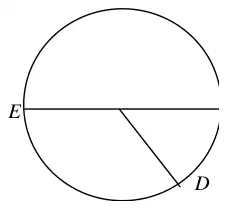
Centre of circle is \(O\)
Angle \(COD = \theta\) Angle \(EOD = \alpha\)
| \(\cos\theta = \dfrac{0.15l}{0.3l}\ \ \ \theta = \dfrac{\pi}{3}\) | M1 |
| \(\alpha = \pi - \dfrac{\pi}{3} = \dfrac{2\pi}{3}\) | B1 |
| \(\omega = \sqrt{\dfrac{2g}{l}}\) | |
| time \(= \dfrac{\alpha}{\omega} = \dfrac{2\pi/3}{\sqrt{\dfrac{2g}{l}}} = \dfrac{2\pi}{3}\sqrt{\dfrac{l}{2g}}\) | M1A1 |