
M2 June 2010 Q2
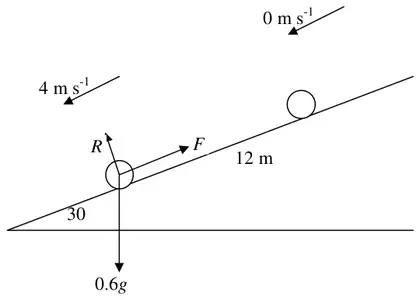
2. A particle \(P\) of mass 0.6 kg is released from rest and slides down a line of greatest slope of a rough plane. The plane is inclined at 30\(^\circ\) to the horizontal. When \(P\) has moved 12 m, its speed is 4 m s\(^{-1}\). Given that friction is the only non-gravitational resistive force acting on \(P\), find
(a) the work done against friction as the speed of \(P\) increases from 0 m s\(^{-1}\) to 4 m s\(^{-1}\), (4)
(b) the coefficient of friction between the particle and the plane. (4)
| Scheme | Marks |
|---|---|
| K.E gained \(= \frac{1}{2} \times 0.6 \times 4^2\) | |
| P.E. lost \(= 0.6 \times g \times (12\sin 30)\) | |
| Change in energy = P.E. lost − K.E. gained | |
| \(= 0.6 \times g \times 12\sin 30 - \frac{1}{2} \times 0.6 \times 4^2\) | M1 A1 A1 |
| \(= 30.48\) | |
| Work done against friction \(= 30\) or 30.5 J | A1 |
| (4) |
| Scheme | Marks |
|---|---|
| \(\text{R}(\uparrow)\quad R = 0.6g\cos 30\) | B1 |
| \(F = \dfrac{30.48}{12}\) | B1ft |
| \(F = \mu R\) | |
| \(\mu = \dfrac{30.48}{12 \times 0.6g\cos 30}\) | M1 |
| \(\mu = 0.4987\) | |
| \(\mu = 0.499\ \) or \(\ 0.50\) | A1 |
| (4) | |
| (8 marks) |