
M2 June 2014 (R) Q7
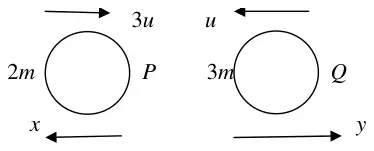
7. A particle \(P\) of mass \(2m\) is moving in a straight line with speed \(3u\) on a smooth horizontal table. A second particle \(Q\) of mass \(3m\) is moving in the opposite direction to \(P\) along the same straight line with speed \(u\). The particle \(P\) collides directly with \(Q\). The direction of motion of \(P\) is reversed by the collision. The coefficient of restitution between \(P\) and \(Q\) is \(e\).
The total kinetic energy of the particles before the collision is \(T\). The total kinetic energy of the particles after the collision is \(kT\). Given that \(e = \dfrac{1}{2}\)
| Scheme | Marks |
|---|---|
| \(6mu - 3mu = 3my - 2mx\) | M1 |
| \(3y - 2x = 3u\) | A1 |
| \(4ue = x + y\) | M1 A1 |
| \(y = \dfrac{u}{5}(8e + 3)\ \ \ \ **\) | DM1 A1 |
| (6) |
Notes
M1 CLM Needs all the terms. Condone sign errors
A1 Correct equation
M1 Impact law. Must be used the right way round.
A1 Correct equation. Signs with \(x\), \(y\) must be consistent with the CLM equation.
DM1 Dependent on the two preceding M marks
A1 Obtain the given result correctly
This is a given result – the candidate needs to show sufficient working to support the answer.
| Scheme | Marks |
|---|---|
| \(x = 4ue - y\) | M1 |
| \(x = \dfrac{1}{5}u(20e - 8e - 3) = \dfrac{3}{5}u(4e - 1)\) | A1 |
| \(x > 0 \Rightarrow e > \dfrac{1}{4}\) | M1 |
| \(\therefore \dfrac{1}{4} < e \leqslant 1\) | A1 |
| (4) |
Notes
M1 Use one of their equations from (a) and \(\pm\) the given \(y\) to find \(x\).
A1 Any equivalent form. Accept \(\pm\)
M1 Use \(x > 0\) to solve find values of e. The inequality must match their \(x\).
A1 Need both limits.
| Scheme | Marks |
|---|---|
| \(e = \dfrac{1}{2}\ \ \ x = \dfrac{3u}{5}\ \ \ \ y = \dfrac{u}{5}(4 + 3) = \dfrac{7u}{5}\) | B1 |
| \(T = \dfrac{1}{2} \times 2m \times 9u^2 + \dfrac{1}{2} \times 3mu^2\ \ \left(= \dfrac{21mu^2}{2}\right)\) | M1 |
| \(kT = \dfrac{1}{2} \times 2m \times \dfrac{9u^2}{25} + \dfrac{1}{2} \times 3m \times \dfrac{49u^2}{25}\ \ \left(= \dfrac{165mu^2}{50}\right)\) | M1 |
| \(k = \dfrac{\frac{1}{2} \times 2 \times \frac{9}{25} + \frac{1}{2} \times 3 \times \frac{49}{25}}{\frac{1}{2} \times 2 \times 9 + \frac{1}{2} \times 3}\ \ \left(\text{or } \dfrac{165}{50} \div \dfrac{21}{2}\right) = \dfrac{11}{35}\) | A1 |
| (4) | |
| (14 marks) |
Notes
B1 Allow \(x = -\dfrac{3u}{5}\)
M1 KE before or KE after, in terms of \(u\)
M1 Second KE in terms of \(u\) and use to find \(k\).
A1 Or equivalent. 0.314 or better