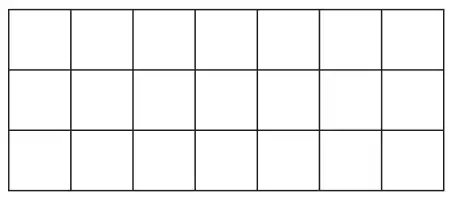
(b) Write \(\dfrac{23}{3}\) as a mixed number. (1)
(c) Find \(\dfrac{2}{5}\) of 60 cm. (2)
Claude says that \(\dfrac{1}{6}\) is exactly halfway between \(\dfrac{1}{4}\) and \(\dfrac{1}{8}\)
(d) Is Claude correct? You must give a reason for your answer. (2)
Mark scheme (a)
Scheme
Marks
9 squares shaded
B1
(1)
Mark scheme (b)
Scheme
Marks
\(7\dfrac{2}{3}\)
B1
(1)
Mark scheme (c)
Scheme
Marks
60 ÷ 5 or 12 or 2 × 60 or 120
M1
24
A1
(2)
Mark scheme (d)
Scheme
Marks
\(\dfrac{1}{4} = \dfrac{4}{16}\) and \(\dfrac{1}{8} = \dfrac{2}{16}\) oe or
\(\dfrac{1}{4} = \dfrac{6}{24}\) and \(\dfrac{1}{8} = \dfrac{3}{24}\) and \(\dfrac{1}{6} = \dfrac{4}{24}\) oe
M1
Correct conclusion based on correct figures
A1
(2)
(6 marks)
Notes
M1: or use of decimals for 0.25 and 0.125
A1: e.g. \(\dfrac{3}{16}\) is halfway between \(\dfrac{1}{4}\) and \(\dfrac{1}{8}\) \(\left(\dfrac{3}{16} \ne \dfrac{1}{6}\right)\) oe or using second method above, 4 is not halfway between 3 and 6 or 0.1875, 0.16666… and No
We'd like to use Google Analytics cookies to count visits and see which pages help most. They're optional, and the site works exactly the same either way. Privacy policy