
Higher November 2019 Paper 2 Q23
23 The diagram shows a parallelogram.
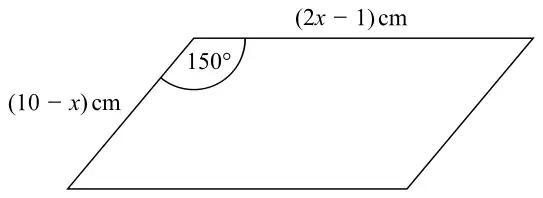
The area of the parallelogram is greater than 15 cm\(^2\)
(a) Show that \(2x^2 - 21x + 40 \lt 0\) (3)
(b) Find the range of possible values of \(x\). (3)
| Answer | Mark | Mark scheme |
|---|---|---|
| Shown | C1 | for a method to find the area of half of the parallelogram or of the whole parallelogram, eg \(\frac{1}{2}(2x - 1)(10 - x)\sin 150\) or \(\frac{1}{2}(2x - 1)(10 - x) \times \frac{1}{2}\) oe or \((2x - 1)(10 - x)\sin 150\) or \((2x - 1)(10 - x) \times \frac{1}{2}\) oe |
| C1 | for a correct expansion of the whole area eg \(\frac{1}{2}(20x - 10 - 2x^2 + x)\) or \(\frac{1}{2}(-2x^2 + 21x - 10)\) or \(-x^2 + 10.5x - 5\) | |
| C1 | complete chain of reasoning with fully correct algebra dealing with the inequality eg \(x^2 - 10.5x + 5 \lt -15\) or \(x^2 - 10.5x + 20 \lt 0\) or \(2x^2 - 21x + 10 \lt -30\) which lead to \(2x^2 - 21x + 40 \lt 0\) |
| Answer | Mark | Mark scheme |
|---|---|---|
| \(2.5 \lt x \lt 8\) | M1 | for factorising, \((2x - 5)(x - 8)\) |
| A1 | for critical values, 2.5, 8 | |
| A1 | for any statement that \(x\) is greater than 2.5 and \(x\) is less than 8 |
Additional guidance
Could use the formula
Need not be given as an inequality statement