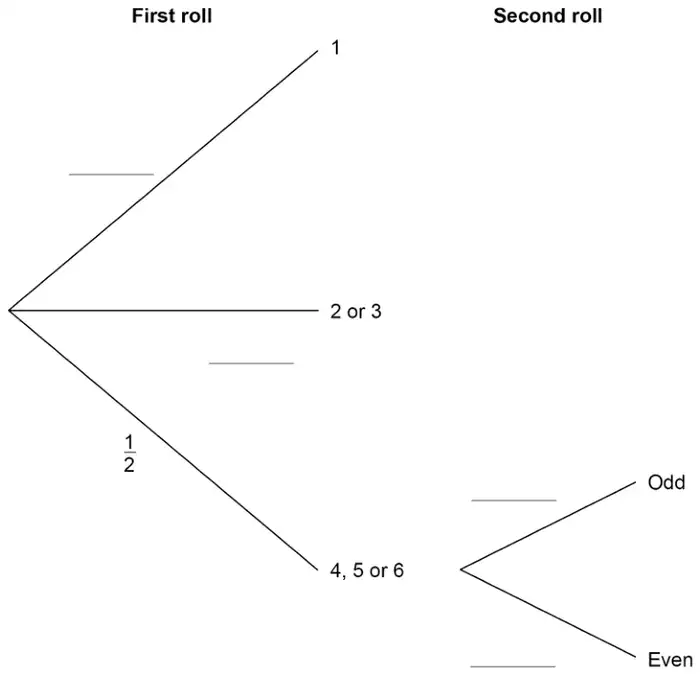
If she rolls 1 she wins. If she rolls 2 or 3 she loses. If she rolls 4, 5 or 6 she rolls again.
When she has to roll again,
if she rolls an odd number she wins if she rolls an even number she loses.
(a) Complete the tree diagram with the four missing probabilities. [2 marks]
(b) Is Anna more likely to win or to lose?
You must work out the probability that she wins. [4 marks]
Mark scheme (a)
Answer
Mark
Comments
\(\dfrac{1}{6}\) on ‘1’ and \(\dfrac{1}{3}\) or \(\dfrac{2}{6}\) on ‘2 or 3’ and \(\dfrac{1}{2}\) on each of ‘Odd’ and ‘Even’
B2
oe fraction, decimal or percentage B1 \(\dfrac{1}{6}\) on ‘1’ and \(\dfrac{1}{3}\) or \(\dfrac{2}{6}\) on ‘2 or 3’ or \(\dfrac{1}{2}\) on each of ‘Odd’ and ‘Even’ or all correct unsimplified probabilities with one or more simplification errors eg \(\dfrac{3}{6}\) on ‘Odd’ simplified to \(\dfrac{1}{3}\)
Additional guidance
Accept decimals or percentages rounded or truncated correctly to at least 2 significant figures
Only withhold a mark for simplification errors if B2 would otherwise be awarded
Ignore extra branches added
Ignore attempts to work out combined probabilities to the right of the tree diagram
If an answer line is blank, the student may have written their answer elsewhere on the branch
Mark scheme (b)
Answer
Mark
Comments
Alternative method 1: P(1) + P(4, 5 or 6) × P(Odd)
\(\dfrac{1}{2} \times\) their \(\dfrac{1}{2}\) or \(\dfrac{1}{4}\)
M1
oe
their \(\dfrac{1}{4} +\) their \(\dfrac{1}{6}\)
M1dep
oe
(P(win) =) \(\dfrac{10}{24}\) or \(\dfrac{5}{12}\)
A1ft
oe ft their tree diagram
Lose (and P(Lose) = \(\dfrac{14}{24}\) or \(\dfrac{7}{12}\) oe)
A1ft
ft correct decision for their \(\dfrac{5}{12}\) (and their \(\dfrac{7}{12}\)) with M2 scored
Alternative method 2: 1 – P(2 or 3) – P(4, 5 or 6) × P(Even)
\(\dfrac{1}{2} \times\) their \(\dfrac{1}{2}\) or \(\dfrac{1}{4}\)
M1
oe
their \(\dfrac{1}{4} +\) their \(\dfrac{1}{3}\) or P(lose) \(= \dfrac{7}{12}\)
M1dep
oe ft their tree diagram
(P(win) =) \(\dfrac{10}{24}\) or \(\dfrac{5}{12}\)
A1ft
oe ft their tree diagram
Lose (and P(Lose) = \(\dfrac{14}{24}\) or \(\dfrac{7}{12}\) oe)
A1ft
ft correct decision for their \(\dfrac{5}{12}\) (and their \(\dfrac{7}{12}\)) with M2 scored
Additional guidance
Check the tree diagram for working
Any ‘their’ or ft probability must be > 0 and < 1 for marks to be awarded
For the second A1ft, the ft can be from an incorrect tree (which may score 4 marks) or an arithmetic error (which scores 3 marks, M1M1A0A1ft)
Accept equivalent fractions or decimals within calculations and equivalent fractions, decimals or percentages for final probabilities
Accept decimals or percentages rounded or truncated correctly to at least 2 significant figures
Condone \(\dfrac{1}{2} \times\) their \(\dfrac{1}{2}\) as part of a longer, incorrect multiplication eg \(\dfrac{1}{2} \times \dfrac{1}{2} \times \dfrac{1}{6}\)
M1M0A0A0
Condone decimals used within fractions eg P(Win) \(= \dfrac{2.5}{6}\)
at least M1M1A1
For the method marks, condone incorrect mathematical notation eg \(\dfrac{1}{2} \times \dfrac{1}{2} = \dfrac{1}{4} + \dfrac{1}{6} = \ldots\)
at least M1M1 (may go on to score 3 or 4 marks)
For the second A1ft, if the student gives a value for P(Lose), their P(Win) + their P(Lose) must equal 1 However, allow a comparison to \(\dfrac{1}{2}\) unless it is clearly an incorrect value for P(Lose)