Nadia says that \(y\) is directly proportional to \(x\) because the value of \(y\) increases by 4 as the value of \(x\) increases by 2
(a) Is Nadia correct? You must give a reason for your answer. (1)
\(w\) is directly proportional to the square root of \(t\).
\(w = 140\) when \(t = 64\)
(b)
(i) Calculate the value of \(w\) when \(t = 7.84\) (3)
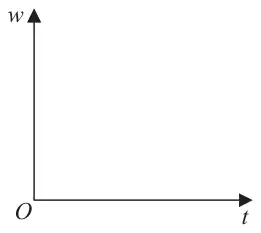
(ii) On the axes below, sketch a graph to show the relationship between \(w\) and \(t\).(1)
Mark scheme (a)
Answer
Mark
Mark scheme
No with reason
C1
for No with reason,
Acceptable examples No, \(4 \div 4 \neq 8 \div 6\) No, \(4 \div 4 \neq 8 \div 6\) so they don’t have the same constant No because \(y = kx\) doesn’t work No, it wont pass through (0, 0)
Not acceptable examples Yes, …. No, they don’t increase by the same number No, they don’t have the same constant
Mark scheme (b)
Answer
Mark
Mark scheme
(i) 49
M1
for stating a correct relationship, eg \(w = k \times \sqrt{t}\) or \(140 = k \times \sqrt{64}\) oe
M1
for method to find constant of proportionality, eg \(140 \div \sqrt{64}\ (= 17.5\) oe\()\)
A1
cao
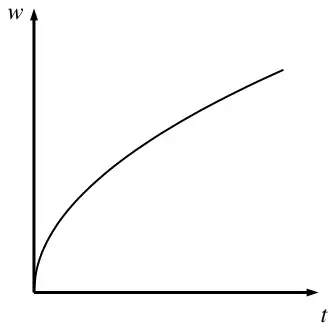
(ii) sketch
C1
for sketch
Additional guidance
(i) Condone the use of ‘\(\alpha\)’ instead of ‘=’ for both M marks