
A2 October 2021 Q6
6.
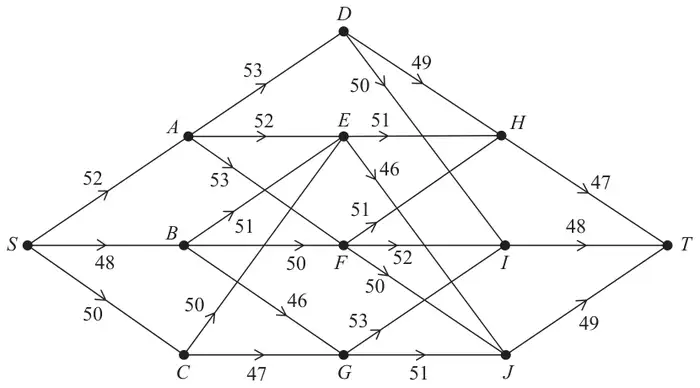
The staged, directed network in Figure 3 represents a series of roads connecting 12 towns, \(S\), \(A\), \(B\), \(C\), \(D\), \(E\), \(F\), \(G\), \(H\), \(I\), \(J\) and \(T\). The number on each arc shows the distance between these towns, in miles.
Bradley is planning a four-day cycle ride from \(S\) to \(T\).
He plans to leave his home at \(S\). On the first night he will stay at \(A\), \(B\) or \(C\), on the second night he will stay at \(D\), \(E\), \(F\) or \(G\), on the third night he will stay at \(H\), \(I\) or \(J\), and he will arrive at his friend’s house at \(T\) on the fourth day.
Bradley decides that the maximum distance he will cycle on any one day should be as small as possible.
| Stage | State | Action | Destination | Value |
|---|---|---|---|---|
| Scheme | Marks | AO |
|---|---|---|
| Minimax | B1 | 1.2 |
| (1) |
Notes
B1: cao
| Scheme | Marks | AO | ||||||||||||||||||||||||||||||||||||||||||||||||||
|---|---|---|---|---|---|---|---|---|---|---|---|---|---|---|---|---|---|---|---|---|---|---|---|---|---|---|---|---|---|---|---|---|---|---|---|---|---|---|---|---|---|---|---|---|---|---|---|---|---|---|---|---|
| B1 | 3.1a | ||||||||||||||||||||||||||||||||||||||||||||||||||
| M1 A1 A1 | 3.1a 1.1b 1.1b | ||||||||||||||||||||||||||||||||||||||||||||||||||
| M1 A1ft A1 | 1.1b 1.1b 1.1b | ||||||||||||||||||||||||||||||||||||||||||||||||||
| M1 A1ft | 1.1b 1.1b | ||||||||||||||||||||||||||||||||||||||||||||||||||
| (9) |
Notes
Throughout (b):
- Condone lack of destination column and/or reversed stage numbers throughout
- Only penalise incorrect result in value – ie ignore working values
- Penalise absence of state or action column with first two A marks earned only
- Penalise empty/errors in stage column with first A mark earned only
- If maximin, minimum, maximum, etc. then only the B mark and M marks can be awarded in (b) (so 4 out of 9 maximum) and one B mark can be awarded in (c) following through a correct route from their table
M marks in (b) - must bring earlier optimal results into calculations at least once
B1: Stage 1 correct
M1: Stage 2 completed with 4 states and at least 9 rows. Bod if something in each cell
A1: Any two states in Stage 2 correct
A1: cao all 4 states correct in Stage 2 (no extra rows)
M1: Stage 3 completed with 3 states and at least 8 rows. Bod if something in each cell
A1ft: cao any 2 states correct in Stage 3 on the follow through
A1: cao all 3 states in Stage 3 (no extra rows)
M1: Stage 4 completed with 1 state and at least 3 rows. Bod if something in each cell
A1ft: cao for Stage 4 following through their * values (no extra rows)
| Scheme | Marks | AO |
|---|---|---|
| Route 1: S – B – F – J – T Route 2: S – C – E – J – T | B1ft B1 | 2.2a 2.2a |
| (2) | ||
| (12 marks) |
Notes
B1ft: One correct route (dependent on first B mark and all M marks in (b)) following through their least values (oe) at each stage in (b)
B1: Both routes correct (dependent on first B mark and all M marks in (b))