
A2 June 2022 Q6
6. The following algorithm determines the number of comparisons made when Prim’s algorithm is applied to \(K_n\)
| Step 1 | Start |
| Step 2 | Input the value of \(n\) |
| Step 3 | Let \(a = 1\) |
| Step 4 | Let \(b = n - 2\) |
| Step 5 | Let \(c = b\) |
| Step 6 | Let \(a = a + 1\) |
| Step 7 | Let \(b = b - 1\) |
| Step 8 | Let \(c = c + (a \times b) + (a - 1)\) |
| Step 9 | If \(b \gt 0\) go to Step 6 |
| Step 10 | Output \(c\) |
| Step 11 | Stop |
You may not need to use all the rows in this table. It may not be necessary to complete all the boxes in each row.
| \(n\) | \(a\) | \(b\) | \(c\) |
|---|---|---|---|
Output: ____________
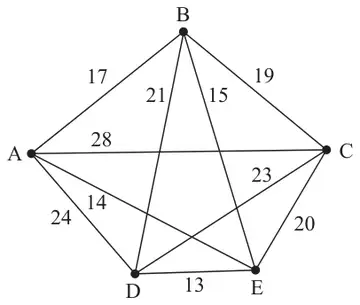
The weights of the ten arcs in Figure 4 are
| 17 | 21 | 24 | 14 | 23 | 13 | 15 | 19 | 28 | 20 |
It is given that the maximum total number of comparisons required to sort the weights of the arcs of \(K_n\) into ascending order using bubble sort is
\(\lambda n(n - 1)(n + 1)(n - 2)\)
where \(\lambda\) is a constant.
| Scheme | Marks | AO | ||||||||||||||||||||
|---|---|---|---|---|---|---|---|---|---|---|---|---|---|---|---|---|---|---|---|---|---|---|
| M1 A1 | 1.1b 1.1b | ||||||||||||||||||||
| Output: 16 | A1 | 2.2a | ||||||||||||||||||||
| (3) |
Notes
(a) M1: At least three rows of cells completed with a correct first row – condone repeated values in all columns or a single value in each row
A1: cao – the values in the second and third rows correct
A1: cao – correct output following a correct fourth row (with no extra rows) – the output must either be stated on the given answer line or ‘output 16’ must be clearly written somewhere near the table (do not bod the 16 circled, underlined, written twice, etc.)
| Scheme | Marks | AO | ||||||||||||||||||||||||||||||||||||||||||||||||||||||||||||||||||||||
|---|---|---|---|---|---|---|---|---|---|---|---|---|---|---|---|---|---|---|---|---|---|---|---|---|---|---|---|---|---|---|---|---|---|---|---|---|---|---|---|---|---|---|---|---|---|---|---|---|---|---|---|---|---|---|---|---|---|---|---|---|---|---|---|---|---|---|---|---|---|---|---|---|
(i)
| M1 A1 A1ft A1 | 1.1b 1.1b 1.1b 1.1b | ||||||||||||||||||||||||||||||||||||||||||||||||||||||||||||||||||||||
| (ii) Total number of comparisons: 9 + 8 + 7 + 6 + 5 + 4 = 39 | B1 | 2.2a | ||||||||||||||||||||||||||||||||||||||||||||||||||||||||||||||||||||||
| (5) |
Notes
(b)(i) M1: Bubble sort. Consistent direction, end number (28) in place, the list containing ten numbers with the list beginning with the correct first five numbers (17 21 14 23 13). Do check these carefully as some candidates show the result of each comparison and swap in their first pass. Consider the placement of the candidate’s numbers, rather than what the candidate labels each line of their pass. For example, assume that the first time that the 28 appears at the end of the list is the end of their first pass
A1: Second and third passes correct – so end three numbers in place
A1ft: Fourth and fifth passes correct following through from the candidate’s third pass – so end five numbers in place. After their third pass their list must contain the correct 10 numbers
A1: cso (correct solution only – so previous three marks must have been awarded in this part). Must show a 6th pass showing no swaps/changes (give bod if the passes are not labelled but do not award this mark if it is clear that after the 5th pass the list is simply being written out again (rather than a genuine 6th pass taking place)). Condone if the sort continues until a 9th pass has been completed (but there must be no changes in the 6th to 9th passes)
(b)(ii) B1: cao (for total number of comparisons)
In (b) starting at the right-hand end of the list is M0. Quick sort (or any other sorting algorithm e.g. shuttle) is M0. No misreads in this part – mark exactly to the scheme.
If sorting into descending order, then award M1 for 21 24 17 23 14 15 19 28 20 13 and the first A1 for both 24 21 23 17 15 19 28 20 14 13 and 24 23 21 17 19 28 20 15 14 13 ONLY (so two out of the first four marks) even if the list is re-ordered after the sort is complete
| Scheme | Marks | AO |
|---|---|---|
| 45 | B1 | 2.2a |
| (1) |
Notes
(c) B1: cao (45)
| Scheme | Marks | AO |
|---|---|---|
| e.g. when \(n = 3\) the total number of comparisons is 3 therefore \(\lambda(3)(3 - 1)(3 + 1)(3 - 2) = 3\) e.g. when \(n = 5\) the total number of comparisons is 45 (from (c)) therefore \(\lambda(5)(5 - 1)(5 + 1)(5 - 2) = 45\) | M1 | 3.1a |
| For \(K_{50}\) total number of comparisons is \(\text{‘}\lambda\text{’}(50)(50 - 1)(50 + 1)(50 - 2)\) | dM1 | 3.4 |
| 749 700 | A1 | 2.2a |
| (3) | ||
| (12 marks) |
Notes
(d) M1: Considering the total number of comparisons for any positive integer value of \(n\) (greater than 2) and substitute into the given expression (if correct \(\lambda = \dfrac{1}{8}\)). The correct value of \(\lambda\) implies this mark. If using \(n = 5\) then follow through their value from (c). If any other value of \(n\) used, then the maximum number of comparisons must be correct e.g.
| \(n\) | 3 | 4 | 5 | 6 | 7 | 8 | 9 | 10 |
|---|---|---|---|---|---|---|---|---|
| Comparisons | 3 | 15 | 45 | 105 | 210 | 378 | 630 | 990 |
dM1: Using their \(\lambda\) and \(n = 50\) to calculate the maximum total number of comparisons (dependent on the previous M mark). Writing \(\dfrac{1}{8}(50)(50 - 1)(50 + 1)(50 - 2)\) implies the first two M marks
A1: cao (749 700) – no marks for the correct answer with no working
Alternative solution to (d) for those who are clearly using an algebraic method to derive the quartic expression for the maximum total number of comparisons:
If there are \(N\) values then
1st pass of bubble sort requires \(N - 1\) comparisons
2nd pass of bubble sort requires \(N - 2\) comparisons
3rd pass of bubble sort requires \(N - 3\) comparisons and so on
Therefore, the total number of comparisons is \(\displaystyle\sum_{r=1}^{N-1} r = \tfrac{1}{2}(N - 1)N\) M1
Maximum number of comparisons in \(K_n\) is therefore
\(\tfrac{1}{2}\left(\tfrac{1}{2}n(n - 1) - 1\right)\left(\tfrac{1}{2}n(n - 1)\right)\)
\(= \tfrac{1}{8}n(n - 1)\left[n(n - 1) - 2\right]\)
\(= \tfrac{1}{8}n(n - 1)(n^2 - n - 2) = \tfrac{1}{8}n(n - 1)(n - 2)(n + 1)\) so \(\lambda = \tfrac{1}{8}\) dM1
Therefore, maximum number of comparisons for \(K_{50}\) is 749 700 A1
M1: Considering the total number of comparisons that are required to sort a list containing \(N\) values (possibly will see \(1 + 2 + 3 + \ldots + (n - 1)\)) and using the standard series result that \(\sum r = \tfrac{1}{2}n(n + 1)\) to get the correct quadratic expression for the total number of comparisons when sorting \(N\) values (allow any letter)
dM1: Dependent on previous M mark – substituting the correct quadratic expression into the correct quadratic expression with correct algebraic working leading to \(\tfrac{1}{8}n(n - 1)(n - 2)(n + 1)\)
A1: Correct answer of 749 700
[Corrected from the printed mark scheme: the alternative solution ends “so \(k = \tfrac{1}{8}\)”; the constant in the question is \(\lambda\).]