
AS June 2018 Q2
2.
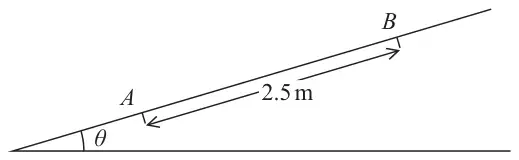
Figure 1 shows a ramp inclined at an angle \(\theta\) to the horizontal, where \(\sin\theta = \dfrac{2}{7}\)
A parcel of mass 4 kg is projected, with speed \(5\ \text{m s}^{-1}\), from a point \(A\) on the ramp.
The parcel moves up a line of greatest slope of the ramp and first comes to instantaneous rest at the point \(B\), where \(AB = 2.5\) m.
The parcel is modelled as a particle.
The total resistance to the motion of the parcel from non-gravitational forces is modelled as a constant force of magnitude \(R\) newtons.
After coming to instantaneous rest at \(B\), the parcel slides back down the ramp. The total resistance to the motion of the particle is modelled as a constant force of magnitude 8.8 N.
| Scheme | Marks | AO |
|---|---|---|
| Work-energy equation: KE lost = PE gained + Work Done | M1 | 2.1 |
| \(\dfrac{1}{2} \times 4 \times 5^2 - 4 \times g \times 2.5 \times \sin\theta = 2.5R\) | A1 | 1.1b |
| \(\dfrac{1}{2} \times 4 \times 5^2 - 4 \times g \times 2.5 \times \dfrac{2}{7} = 2.5R\) | A1 | 1.1b |
| \(2.5R = 22 \Rightarrow R = 8.8\) * | A1* | 1.1b |
| (4) |
Notes
M1: A complete method to obtain \(R\). The question requires the use of work-energy. Need to consider all three terms with no duplication. Condone sign error and sin/cos confusion.
A1: Unsimplified equation with at most one error
A1: Correct unsimplified
A1*: Correct answer with sufficient working shown to justify given answer
| Scheme | Marks | AO |
|---|---|---|
| Work-energy equation: KE after = initial KE – 2 (Work Done) | M1 | 3.3 |
| \(\dfrac{1}{2} \times 4 \times v^2 = \dfrac{1}{2} \times 4 \times 25 - 2 \times 8.8 \times 2.5\) | A1 | 1.1b |
| \(\Rightarrow 2v^2 = 6,\ v = 1.7\ (\text{m s}^{-1})\) | A1 | 1.1b |
| (3) |
Notes
M1: Work-energy equation considering \(A \rightarrow A\) or \(B \rightarrow A\). Requires all relevant terms with no duplication. Condone sign errors and sin/cos confusion
A1: Correct unsimplified equation
A1: Accept 1.7 or 1.73 (answer depends on use of g). Not \(\sqrt{3}\)
Alternative (b)
| Scheme | Marks | AO |
|---|---|---|
| Work-energy equation: KE at \(A\) = PE lost – Work Done | M1 | |
| \(\dfrac{1}{2} \times 4 \times v^2 = 4 \times 9.8 \times \dfrac{2}{7} \times 2.5 - 8.8 \times 2.5\) | A1 | |
| \(\Rightarrow 2v^2 = 6,\ v = 1.7\ (\text{m s}^{-1})\) | A1 | |
| (3) |
(corrected from the printed mark scheme: “KE at \(B\)”, but the kinetic energy found is at \(A\); the parcel is at rest at \(B\))
Alternative (b)
| Scheme | Marks | AO |
|---|---|---|
| Equation of motion and suvat: \(4g\sin\theta - 8.8 = 4a \quad (a = 0.6)\) | M1 | |
| \(v^2 = 2 \times a \times 2.5\) | A1 | |
| \(v = 1.7\ (\text{m s}^{-1})\) | A1 | |
| (3) |
M1: Complete method to find \(v\) or \(v^2\).
A1: Correct unsimplified expression for \(v\) or \(v^2\).
A1: Accept 1.7 or 1.73 (answer depends on use of g)
| Scheme | Marks | AO |
|---|---|---|
| A valid improvement | B1 | 3.5c |
| A second valid, distinct, improvement | B1 | 3.5c |
| (2) | ||
| (9 marks) |
Notes
B1: it has assumed a constant resistance - have variable resistance
-have air resistance proportional to speed ……
B1: Do not model the parcel as a particle
- so can consider the possibility that the parcel rotates as it moves up/down the slope
- consider the dimensions of the parcel
The comments need to relate to the 2 modelling assumptions in the question. Air resistance and friction are already included in "non-gravitational forces".