
AS June 2022 Q4
4.
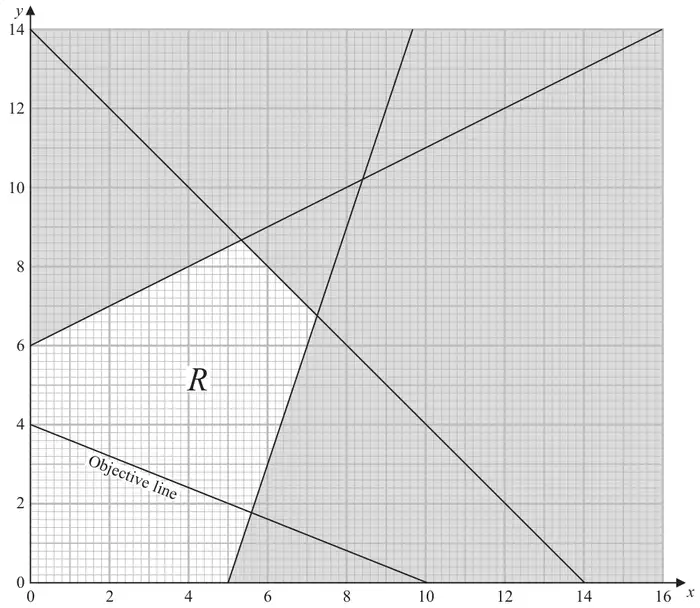
Figure 3 shows the constraints of a maximisation linear programming problem in \(x\) and \(y\), where \(x \geqslant 0\) and \(y \geqslant 0\). The unshaded area, including its boundaries, forms the feasible region, \(R\). An objective line has been drawn and labelled on the graph.
The optimal value of the objective function is 216
Given that \(x\) represents the number of small flower pots and \(y\) represents the number of large flower pots supplied to a customer,
| Scheme | Marks | AO |
|---|---|---|
| \(x + y \leqslant 14\) \(2y - x \leqslant 12\) \(3x - y \leqslant 15\) \((x \geqslant 0,\ y \geqslant 0)\) | M1 A1 A1 | 3.3 1.1b 2.5 |
| (3) |
Notes
M1: One correct non-trivial inequality in any form e.g. \(x - 2y + 12 \geqslant 0\). Condone strict inequality. Must be simplified to three terms only but coefficients do not need to be integers
A1: Two correct non-trivial inequalities in any form e.g. \(x - 2y + 12 \geqslant 0\). Condone strict inequalities. Must be simplified to three terms only but coefficients do not need to be integers
A1: All three non-trivial inequalities correct with three terms and integer coefficients
| Scheme | Marks | AO |
|---|---|---|
| (i) Attempts to solve two equations to find optimal vertex | M1 | 3.4 |
| \(\left(\dfrac{16}{3},\ \dfrac{26}{3}\right)\) | A1 | 1.1b |
| (ii) \(P = k(4x + 10y)\) | M1 | 3.1a |
| \(216 = k\left(4 \times \dfrac{16}{3} + 10 \times \dfrac{26}{3}\right)\) | ddM1 | 3.4 |
| \((P =)\ 8x + 20y\) | A1 | 2.2a |
| (5) |
Notes
(b)(i) M1: Attempt to solve their \(x + y = 14\) and \(2y - x = 12\) (so their line with negative gradient and their line that passes through (0, 6)) simultaneously with at least one equation correct – the correct answer with no working implies this mark
A1: cao \(\left(\dfrac{16}{3},\ \dfrac{26}{3}\right)\) or \(\left(5\dfrac{1}{3},\ 8\dfrac{2}{3}\right)\) - must be exact (allow \(x = \ldots,\ y = \ldots\)) and clearly stated as the optimal vertex if more than one vertex of the FR found
(b)(ii) M1: Expression comprising of a constant (unknown) multiple/factor of \(2x + 5y\) e.g. \(k(4x + 10y)\) - M0 if assuming the objective is \(4x + 10y\) or if no \(k\) (or equivalent letter)
ddM1: Dependent on both previous M marks. Forming an equation with the expression \(k(4x + 10y)\) (or any multiple/factor of this), the 216 and their optimal vertex
A1: cao – accept \(8x + 20y\) or this expression equal to any letter but not for e.g. \(8x + 20y = 0\) or 216
| Scheme | Marks | AO |
|---|---|---|
| 6 small (flower pots) and 8 large (flower pots) | B1 | 3.2a |
| (1) | ||
| (9 marks) |
Notes
B1: 6 small and 8 large – not for (6, 8) or \(x = 6,\ y = 8\) – must be in context